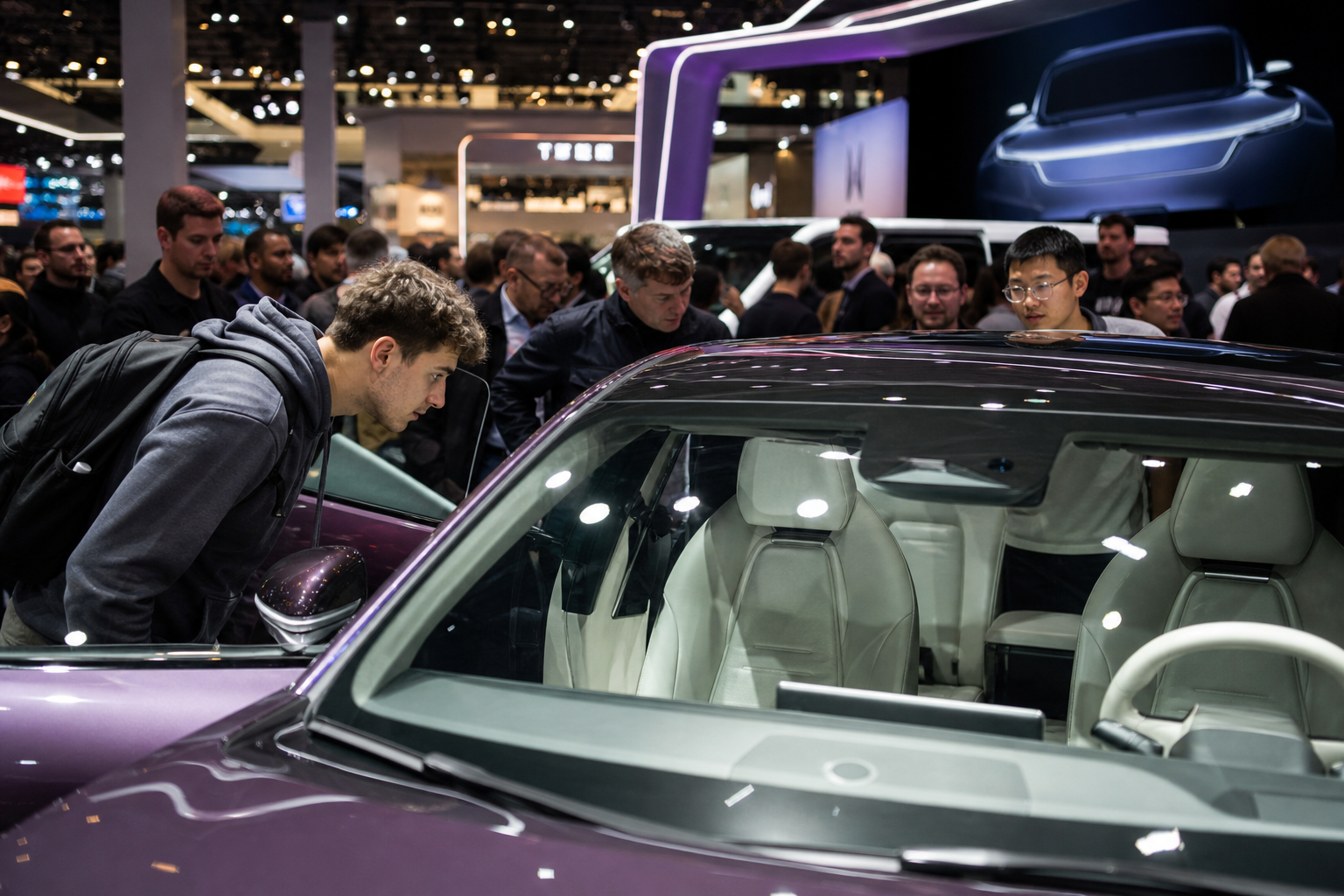
The Paris Mondial de l’Auto closed with 518,372 visitors — 10,365 more than in 2024 — and some of its busiest stands belonged not to France’s household names but to Chinese newcomers seeking a foothold in Europe. The total is not a count of visitors to Chinese displays, nor proof that curiosity will become sales. But the queues, close inspections and sales-floor questions around brands such as BYD, Zeekr, XPeng and Denza offered a conspicuous measure of how quickly the European market is changing.
At a show once dominated by domestic manufacturers and German heavyweights, Chinese groups arrived with electric cars, hybrids and software-rich cabins that invited shoppers to compare equipment as much as badges. Organisers counted more than 86,000 visitors a day across the six-day event, a pace above the daily rate recorded in the show’s 2004 peak year. The attendance gain was modest — 2% — but it came while new-car sales remain difficult and the industry is wrestling with the cost and timing of the shift to electric vehicles.
Twenty-five Chinese marques, represented by 16 manufacturers, were among roughly 60 brands on display, according to the organisers. Serge Gachot, the Mondial’s director general, said Chinese brands accounted for about 40% of the marques present. Either measure marked a sharp expansion from the previous edition and made the Chinese presence impossible to treat as a fringe attraction.
The crowds in Paris showed attention, not allegiance — but attention is the first scarce commodity in a crowded car market.
The showroom comparison has changed
Reports from the floor described visitors measuring boots, folding rear seats and questioning sales staff at the Zeekr, XPeng, Denza and BYD stands with the practical intensity of prospective buyers. The interest centred on the features now shaping the electric-car contest: perceived cabin quality, interior space, screens and connected functions, charging claims and generous standard equipment. That matters because European carmakers are no longer competing only on motors, chassis engineering and long-established dealer relationships.
They face rivals that present the vehicle as a software-led consumer product, often with high specifications at prices designed to make an equivalent European model look sparse. The pressure is uneven. Numerama reported that lesser-known Chinese entrants including Changan, Deepal and Avatr attracted thinner crowds, while Geely drew only a limited number of visitors.
A large national presence does not erase the hard work of building recognition, dealers, repair capacity and consumer trust across fragmented European markets. Nor did the European brands surrender the stage. French manufacturers used concepts and dramatic display cars to assert design and heritage, while established groups retain large service networks, manufacturing bases and familiarity with local buyers.
Those assets may prove more durable than a week of foot traffic. But the show exposed a more immediate problem: the comparison shoppers can now make. A visitor who can sit in a Chinese electric SUV, test its interface and inspect its finish is no longer weighing an abstract threat from abroad.
They are comparing a tangible alternative against the Renault, Volkswagen or Stellantis model across the aisle.
Tariffs have not stopped the advance
The Paris event unfolded amid continuing trade friction between Brussels and Beijing. European measures aimed at countering what the EU sees as unfairly subsidised Chinese battery-electric imports have raised the cost of bringing some models into the bloc. Yet tariffs have changed the route into Europe more than they have removed the competitive challenge.
Euronews reported that Chinese groups are increasingly making cars in European factories to reduce tariff exposure, while a new arrangement was described as limiting Chinese hybrid exports to the EU. The strategic implication is clear even if the details of future trade rules remain unsettled: a company able to assemble locally, source locally and establish a service network can become less vulnerable to border measures. Chinese manufacturers also have reason to diversify beyond pure battery-electric cars.
Hybrids and plug-in hybrids can appeal to drivers wary of charging infrastructure or purchase prices, though the regulatory treatment of those vehicles remains politically contested. The Paris show displayed that the contest will not be settled by one powertrain or one tariff category. For Europe’s legacy manufacturers, the immediate task is less theatrical than the stands at Porte de Versailles suggested.
They must bring down electric-vehicle costs, improve digital systems and preserve margins while supporting factories and workers through the transition. Their Chinese challengers must prove that their display-floor promise survives the less glamorous tests of residual values, spare parts, warranties and resale. Paris did not settle those questions.
It did show that Chinese brands have moved from being an industrial-policy debate in Brussels to a live consumer choice on a European showroom floor.