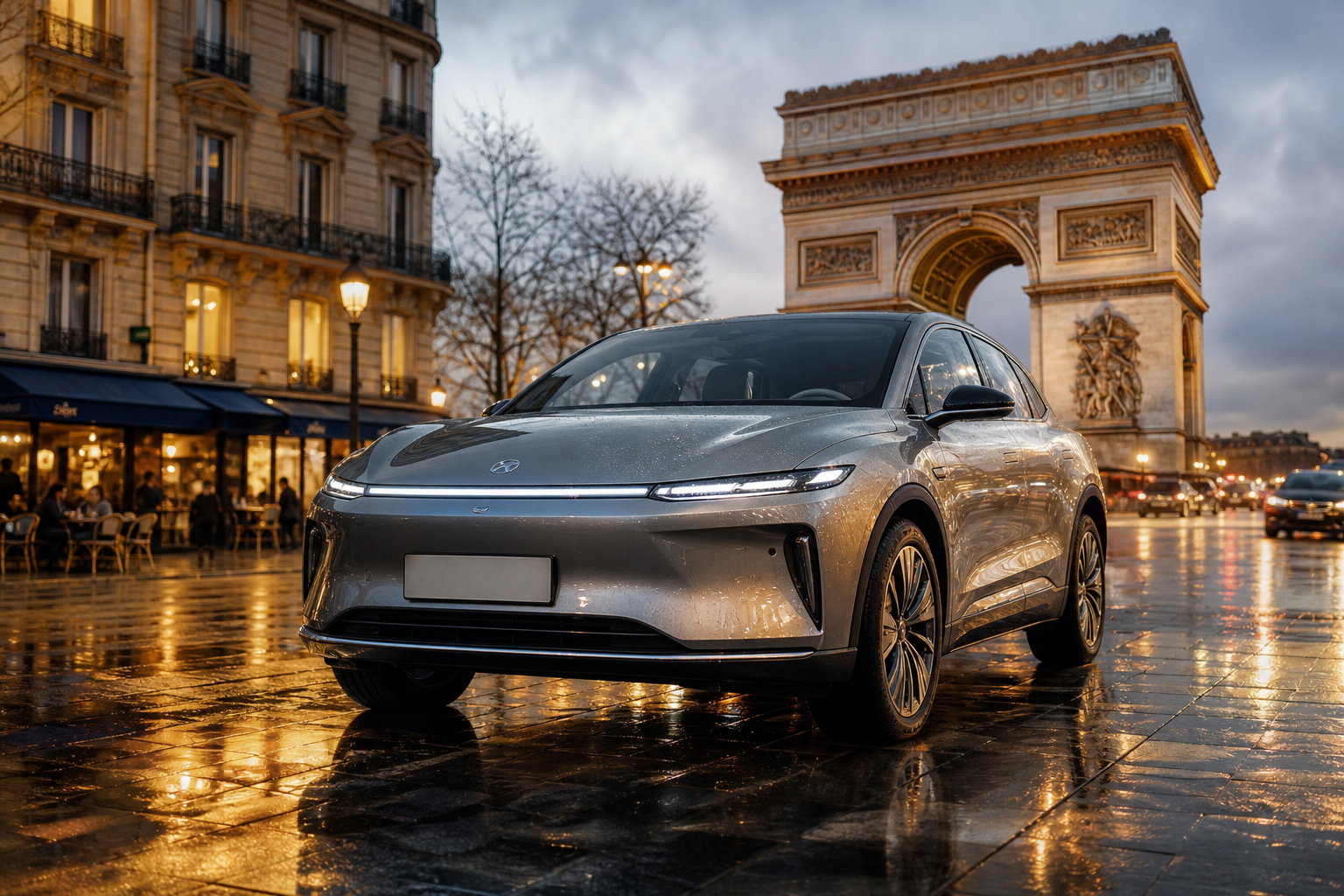
The European Union and China have reached a preliminary understanding to curb Chinese hybrid and plug-in hybrid vehicle exports, placing a proposed annual ceiling of about 350,000 imported cars at the centre of a wider bargain on tariffs and critical minerals. The deal is not yet a settled treaty. EU leaders must still assess the outcome, and the mechanics of the quota — expected to begin in December if member states approve it — remain unresolved.
But the Brussels-Beijing understanding marks a shift from the punitive tariffs imposed on Chinese battery-electric cars in 2024 towards managed trade: protect European manufacturers from a sudden surge, while giving Chinese producers a defined route into the market. The immediate prize for both sides is containment. Chinese hybrid imports have become a fast-growing alternative route into Europe after the EU imposed countervailing duties of 7.8% to 35.3% on China-made battery-electric vehicles.
China says EU imports of its hybrids rose from 107,000 in 2024 to 302,000 in 2025. EU officials say the new arrangement could cut projected Chinese hybrid and plug-in hybrid exports by more than half over four years, compared with a no-policy-change scenario. That is an industrial-policy intervention with a diplomatic purpose.
European carmakers face a difficult transition from combustion engines, with price-sensitive hybrid sales offering a valuable bridge while they attempt to close a technology and cost gap with Chinese competitors. Beijing, meanwhile, avoids an immediate extension of the EU’s electric-car dispute into a more expansive confrontation over hybrid vehicles.
“A crucial first step – but only a first step,” Trade Commissioner Maroš Šefčovič said of the wider rebalancing effort.
A quota with awkward edges
The proposed 350,000-vehicle threshold is large enough to preserve substantial Chinese access to the EU market, but well below the volume implied by the recent pace of trade. Reporting on the arrangement put Chinese hybrid and plug-in hybrid sales in Europe on track for roughly 800,000 vehicles this year. The intended restraint is therefore directed at expected growth, rather than a simple return to the small import volumes of only two years ago.
The design also carries an uncomfortable legal and political constraint. A safeguard mechanism must observe World Trade Organization non-discrimination rules; China says its allocation cannot be lower than that offered to any other source of imports. In practice, that means Brussels cannot easily construct a China-only barrier without extending the framework to other non-EEA exporters.
China has publicly reserved its rights to seek WTO dispute settlement or trade compensation. Its commerce ministry nevertheless described the understanding as allowing further increases from the 2025 import base and room for Chinese companies to maintain steady export growth. That language suggests Beijing sees the arrangement less as a capitulation than as a ceiling it can negotiate around.
The most consequential escape route may be production inside Europe. Chinese-branded vehicles assembled in the EU are expected to be exempt from the quota, while European-branded cars built in China would count against it. The rule gives Chinese manufacturers a stronger incentive to localise assembly, components and logistics in member states such as Hungary or Spain.
It also exposes a politically difficult asymmetry for European groups whose manufacturing footprints remain in China.
Protection without a clean price tag For
European manufacturers, the quota offers breathing room rather than a cure. It cannot by itself solve their high energy costs, weaker battery supply chains or the challenge of producing affordable electrified cars. Nor does it remove the existing anti-subsidy duties on battery-electric vehicles from China.
Separate procedures covering possible company price undertakings for those cars continue. Consumers may eventually pay for the breathing room. If the quota binds tightly, fewer low-cost Chinese hybrid models would be available at European dealerships, reducing competitive pressure on prices in a segment where households are often reluctant to make the jump to a fully electric car.
No official distribution formula among member states or individual manufacturers has yet been set out, making any retail-price forecast premature. The package contains compensation for Europe beyond cars. China has agreed in principle to lower most-favoured-nation tariffs on EU goods with nearly €4bn in current export value, including car parts, olive oil and footwear.
Brussels says that could save European exporters at least €225m in duties. The sides also reached an understanding intended to facilitate Chinese export licences for rare earths and permanent magnets, materials essential to Europe’s automotive and clean-energy industries. Those concessions explain why Brussels is presenting the hybrid curb as a trade rebalancing measure rather than a new wall around the single market.
Yet the agreement leaves customs authorities with a practical test: how to enforce a quota once it is reached, monitor complex supply chains and prevent origin rules from becoming a paper exercise.