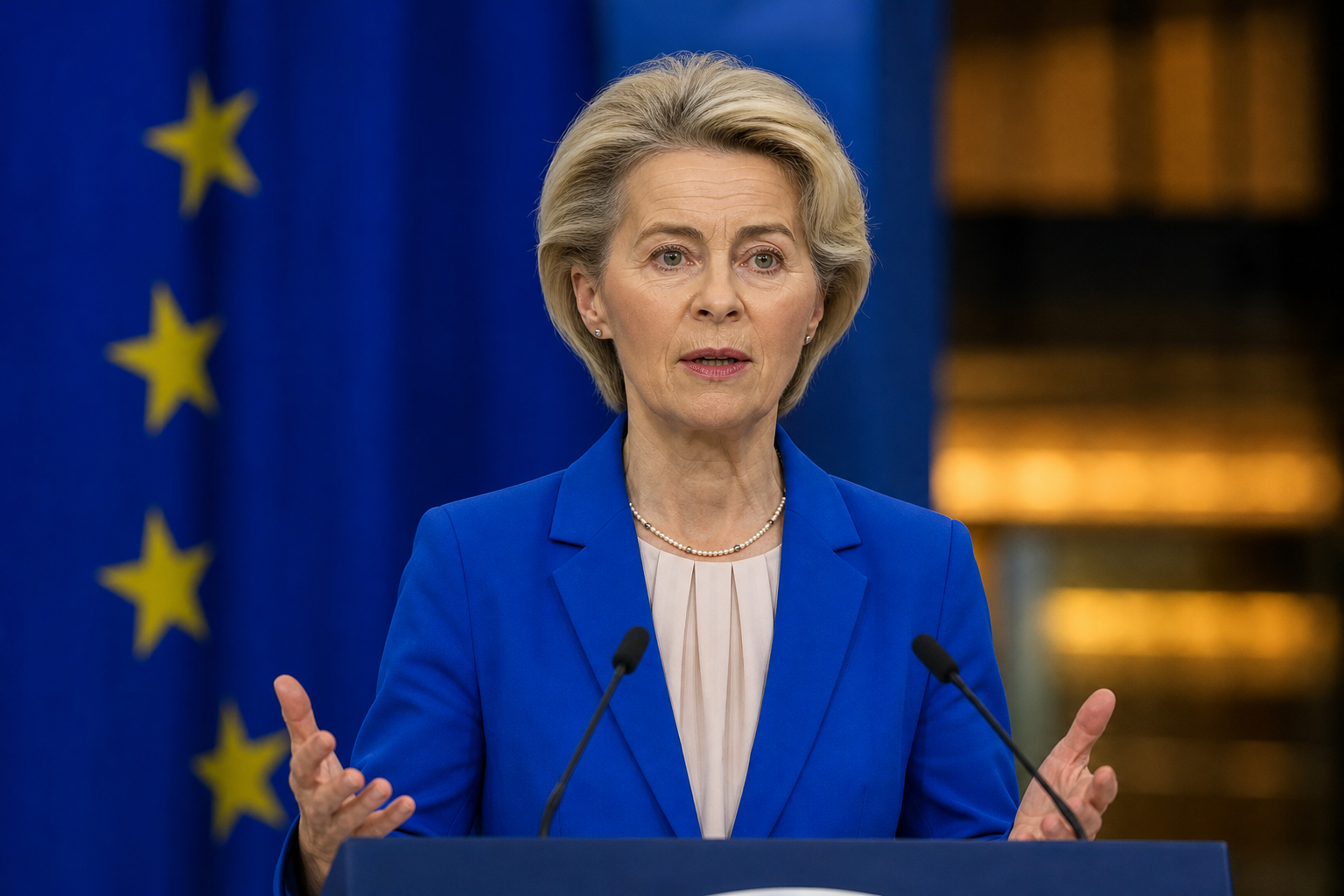
The European Union has opened the prospect of making Canada its first “associate member”, a political proposal that would move the relationship beyond the existing Canada-EU trade agreement but whose legal meaning, institutional terms and support among EU governments remain unsettled. European Commission President Ursula von der Leyen made the offer in her September 16 State of the Union address in Strasbourg, saying she wanted to work with Prime Minister Mark Carney on “opening the door” to associate membership. She coupled it with an outline for an “Alliance for the Future” spanning manufacturing, technology, defence industry, Arctic cooperation, energy, critical minerals, batteries, artificial intelligence, quantum technology, cyber security and economic security.
The proposal matters because it signals an effort to build a more structured Canada-EU economic and security partnership at a moment when both sides are arguing for greater strategic autonomy. But it is not an agreement, and neither Brussels nor Ottawa has set out what associate membership would confer in practice — including any role in EU decision-making, regulatory obligations, budget contributions or legal oversight. Carney welcomed the ambition in an address to the European Parliament the following day, while casting the project as a partnership to be designed jointly.
“An alliance for the future is a unique, positive approach that we will define together,” he said. He also sought to limit its geopolitical interpretation. “I am not proposing a third bloc in order to become a great-power rival — only with better manners,” Carney told MEPs.
A framework beyond CETA Von der
Leyen described the proposed alliance as a step “from CETA” — the EU-Canada Comprehensive Economic and Trade Agreement — toward what she called a common prosperity and economic-security space. Her formulation put industrial policy and security alongside trade, reflecting a broader European push to protect supply chains and build capacity in strategically sensitive sectors. Carney’s response supplied a more detailed Canadian agenda.
He called for cooperation on critical minerals, defence industrial capacity, AI and computing, energy security, space and payments. He also proposed Canadian participation in Erasmus+ and the next generation of the Horizon research programme, as well as exploring an integrated market for financial services. That programme would deepen a relationship that has already acquired a defence-industrial component.
Canada joined the EU’s Security Action for Europe, or SAFE, instrument this year, becoming the first non-European country to take part. Ottawa and Brussels are due to meet again at a Canada-EU summit in Canada on October 29 and 30. The emerging agenda has a practical logic: Canada offers energy, mineral and industrial capabilities that European policymakers increasingly treat as strategic, while the EU offers a large regulatory and commercial market.
Yet the language of associate membership goes further than a sectoral partnership. It raises the question of whether the EU can create a durable institutional category for a close, non-European partner without blurring the distinction between member states, candidate countries and outside allies.
Capitals still need persuading That question is not academic. The chair of the European Parliament’s delegation for relations with Canada
said the “precise meaning” of associate membership must now be defined, including its legal and institutional implications. The political groundwork inside the Union also appears incomplete. POLITICO reported, citing four diplomats, that the idea had not been put to EU capitals in advance and had prompted confusion.
The publication said that an advance version of the speech seen by one government did not contain the associate-membership wording. Canadian officials have likewise stressed that the proposal remains preliminary. Jonathan Wilkinson, Canada’s incoming ambassador to the EU, told reporters in Strasbourg: “We’re not there.” Those qualifications are central to the significance of von der Leyen’s intervention.
The Commission president has set a direction and attached it to a substantial industrial and security agenda, but a political invitation does not establish a new EU status. Any eventual arrangement would have to reconcile Canadian ambitions with the interests of EU institutions and member states, as well as define what participation without full membership would mean.
Partnership, not replacement Carney’s
European speech framed the initiative in terms of resilience rather than separation from North America. He argued that Canada and Europe should secure strategic autonomy through deeper cooperation, while rejecting the idea of constructing a rival power bloc. Von der Leyen made a similar point when she said the alliance would be “not against anyone else, but for our common strength.” The wording leaves room for the Canada-EU project to coexist with Canada’s established North American economic and security ties.
Still, the proposal introduces a new institutional ambition into transatlantic relations. CETA created an extensive trade framework; SAFE brought Canada into a European defence financing instrument.