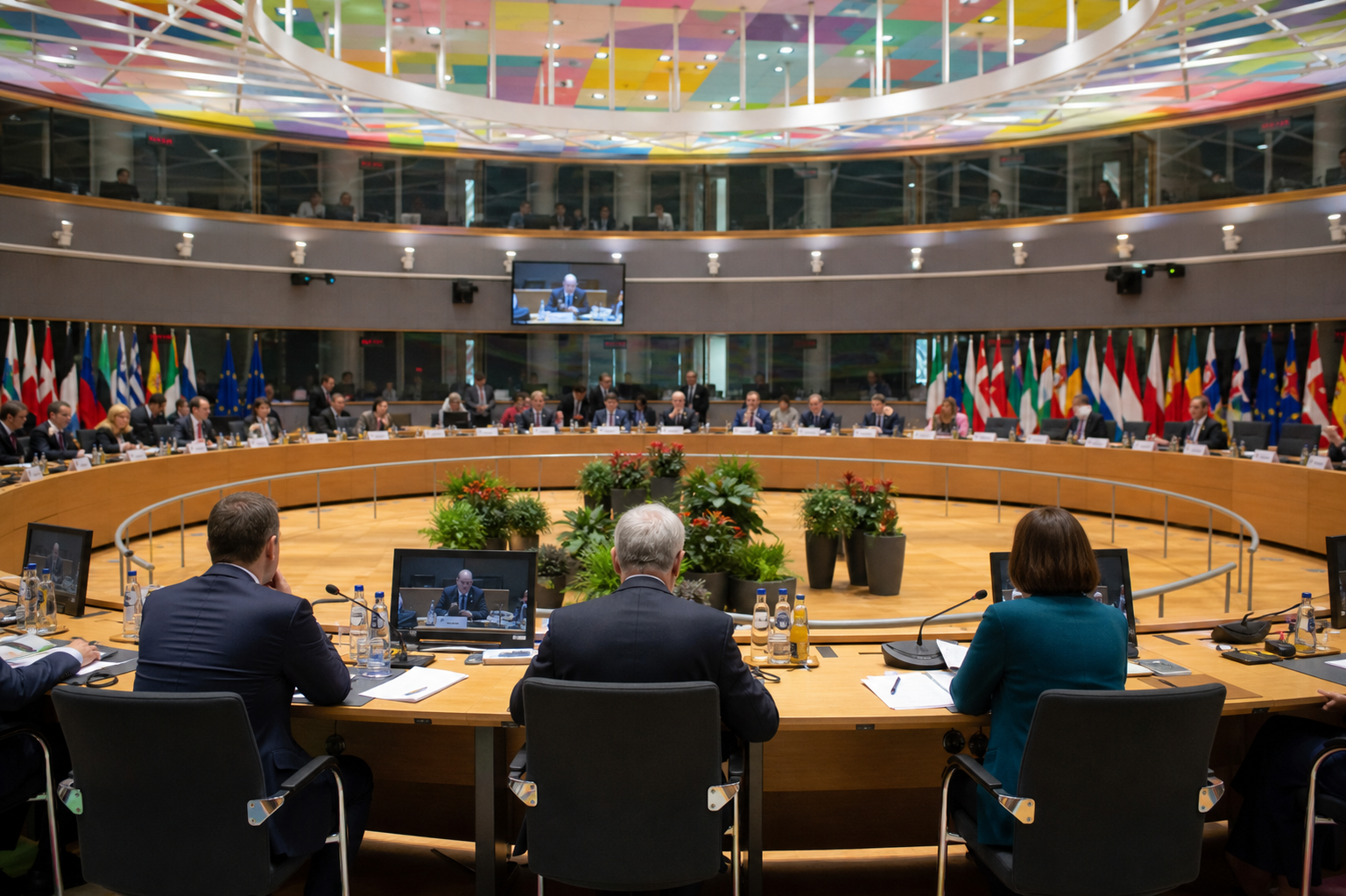
The European Union on 13 October opened two further accession-negotiation clusters with Ukraine and Moldova, moving both candidates into the dense legal work of joining the single market rather than merely declaring political intent. Cluster 2, on the internal market, and Cluster 3, on competitiveness and inclusive growth, bring rules on the movement of goods, services, workers and capital into the centre of negotiations. They also cover competition policy, financial services, company law, consumer protection, taxation, industrial policy, digital transformation, employment, research and education.
The decision gives Kyiv and Chisinau four of the EU’s six negotiating clusters open, encompassing 24 of the bloc’s 33 accession chapters. Cluster 1, covering the fundamentals of democratic institutions and rule of law, opened in June; Cluster 6, on external relations, followed in July. That sequence matters.
The new clusters are where a candidate country’s promises meet the machinery of the European economy: regulators, courts, customs systems, competition authorities, company registers and ministries capable of enforcing common rules long after a law has passed parliament.
A test of implementation, not a membership promise
The Council has set benchmarks for the eventual provisional closure of the newly opened chapters. The Commission will continue monitoring alignment with the EU’s body of law, or acquis, and its implementation. Opening a cluster is therefore a procedural advance, not a guarantee that a chapter will close, still less that membership is near.
The negotiations have now reached the rules that make market access credible: enforcement, supervision and administrative capacity.
For Ukraine, that work must proceed while the state is fighting Russia’s invasion and keeping its economy functioning under wartime pressure. Its accession case rests partly on the political argument that the country belongs securely in Europe; the internal-market cluster asks a more prosaic question: can institutions apply EU rules consistently across firms, sectors and regions? Moldova faces a different version of the same test.
Its smaller economy and administration may make some legal transposition more manageable, but sustained implementation will require specialist regulators, judicial capacity and insulation from political interference. Both countries must show that rules on paper can govern market conduct in practice. The paired advance should not obscure those differences.
Brussels has kept Ukraine and Moldova moving together through the opening stages of the process, a powerful political signal after Russia’s full-scale war against Ukraine reshaped enlargement policy. But accession negotiations remain merit-based. One candidate’s pace is not formally guaranteed by the other’s, and technical performance can still pull the tracks apart.
The economic core of enlargement
The internal-market cluster is especially consequential because it reaches beyond tariff reduction. Free movement of goods depends on product standards, market surveillance and customs administration. Free movement of services and capital requires predictable licensing, corporate rules and financial supervision.
Competition policy demands authorities able to investigate state aid and anti-competitive conduct even when influential domestic interests are affected. Cluster 3 adds another layer. Tax administration, economic and monetary policy, digital rules, labour protections, education, research and industrial policy may appear less politically dramatic than constitutional reform.
Yet they shape whether businesses can compete under common European conditions and whether workers, consumers and investors experience accession as a practical improvement. That is also where friction will be sharpest. Aligning industrial and agricultural economies with EU standards can expose sectors accustomed to national protections or different regulatory costs.
Sensitive trade questions, particularly around agriculture and transport, have already shown how readily economic anxieties in member states can become political obstacles. Negotiations can proceed only while all 27 governments retain the will to approve each next step.
Hungary’s leverage remains part of the equation
Unanimity was secured after Ukraine adopted minority-education legislation that addressed concerns raised by Hungary, according to reporting by the Kyiv Post. The timing illustrated a durable feature of enlargement: technical chapters may be negotiated by experts, but their opening and closing remain vulnerable to member-state politics. Budapest’s concerns have centred on the rights of Ukraine’s Hungarian minority, particularly in education.
Kyiv’s legislative move helped clear the immediate hurdle, but it did not remove the possibility that Hungary or another government could seek further assurances as later clusters come forward. The accession method gives every member state leverage, including over issues that sit outside the narrow content of a given chapter. The remaining unopened clusters cover the green agenda and sustainable connectivity, and resources, agriculture and cohesion.
Brussels wants progress on them by the end of the year, but neither candidate should be judged by the number of clusters opened alone. The harder measure will be whether Ukraine and Moldova can turn this week’s diplomatic milestone into durable regulatory change: fairer competition, more reliable market oversight and institutions strong enough to withstand both domestic pressure and the long, uneven politics of enlargement.