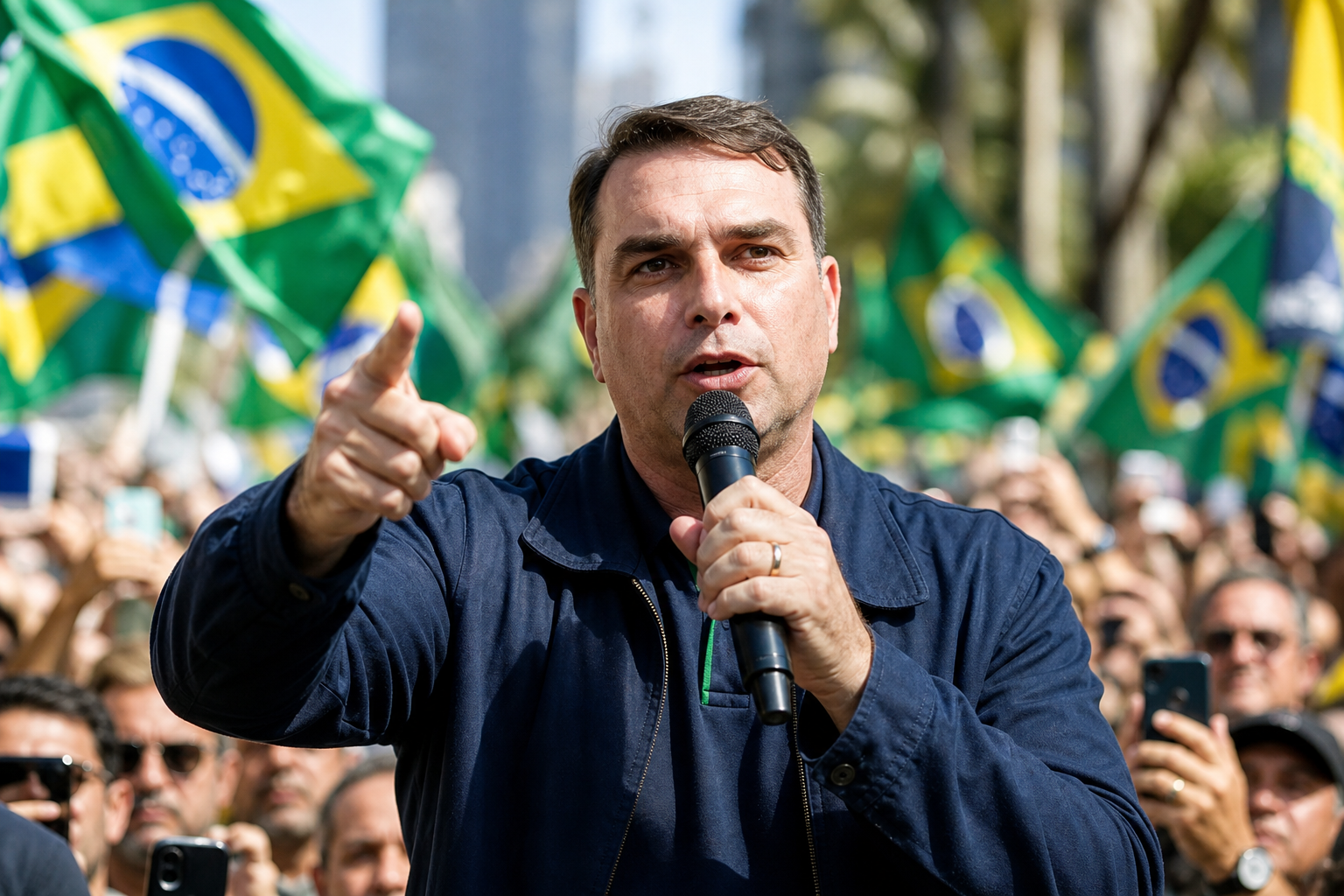
Brazil’s electoral court recorded Flávio Bolsonaro’s 47.03 per cent first-round result on 4 October, ahead of President Luiz Inácio Lula da Silva’s 45.16 per cent. Neither cleared 50 per cent, sending Latin America’s largest democracy to a 25 October runoff in which the Bolsonaro son now holds a narrow polling advantage. The contest offers a sharper choice than the surname alone suggests.
Bolsonaro’s 76-page programme pairs hard-line security policies with spending restraint, tax changes and a more Washington-facing foreign policy. He is selling a less combustible version of Bolsonarism: orderly government, market-friendly reform and transactional diplomacy. Yet the campaign’s defining family commitment remains a route out of prison for his father, Jair Bolsonaro, convicted over an attempted coup and serving a 27-year, three-month sentence.
That tension will shape any victory. Flávio Bolsonaro has chosen Alfredo Gaspar, a former prosecutor and first-term federal deputy, as his running mate, and his party will enter the next Congress with 121 deputies and 28 senators—the largest single-party blocs in both chambers. It is a formidable base for reforms, but also for the amnesty project now being discussed by PL allies.
A leaner state and a tougher criminal code The registered government plan promises to abolish at least 10 ministries, curb political appointments and high public-sector salaries, and replace Lula’s fiscal framework with rules intended to stabilise and then reduce debt relative to GDP. It also proposes revisiting the consumption-tax reform, lowering the VAT rate, exempting exports and investment, and reopening privatisation on a case-by-case basis. The programme promises continued social assistance, while directing beneficiaries toward work. The document gives voters a recognisable political offer, but less detail on its arithmetic. G1 reported on 5 October that the plan does not specify savings from its ministry cuts or identify the permanent reductions needed to deliver them. Daniella Marques, an economic adviser to the campaign, has said the target would be spending cuts equal to 1.5 per cent of GDP. Security is more concrete and more central. Bolsonaro proposes treating criminal factions as narco-terrorist organisations, lowering the age of criminal responsibility to 16, building five maximum-security federal prisons and taking tougher positions on sentencing. His campaign has made everyday fear its organising emotion, from mobile-phone theft to neighbourhoods controlled by gangs. Political scientist Paulo Niccoli Ramirez told the Buenos Aires Herald on 11 October that Bolsonarism’s social-media machinery remained a potent force in shaping voters’ views.
“My relationship with China will always be economically pragmatic,” Bolsonaro said on 21 September.
A Westward tilt, with China still in view If elected,
Bolsonaro says he would seek Brazil’s entry into Donald Trump’s proposed “Shield of the Americas”, pursue a rapid free-trade agreement with the United States and build rare-earth partnerships with Washington. His programme gives priority to OECD accession and closer relations with the US, Israel and Argentina. It gives little prominence to BRICS, although a Brazilian withdrawal is not a settled policy: he has said he would reassess membership, not announced an irrevocable exit.
That is a significant potential shift for Brasília, whose diplomacy under Lula has emphasised multilateralism and the Global South. Reuters reported on 9 October that the next president must still manage relations with Brazil’s two biggest trading partners, China and the United States, while disputes over tariffs and critical minerals intensify. Bolsonaro’s China language suggests a hedge against the economic cost of turning an ideological gesture into a rupture.
His broader moderation is partly tonal. The first Datafolha runoff survey, conducted on 6-7 October, put him on 49 per cent to Lula’s 45 per cent, or 52-48 among valid votes; the institute described the contest as a technical tie at the edge of its two-point margin of error. That lead followed a campaign in which Bolsonaro avoided many of the provocations associated with his father while drawing support from conservatives beyond the family’s most committed base.
The unresolved question of Jair Bolsonaro
The clearest limit to that repositioning is the former president’s fate. Flávio Bolsonaro has made clemency for his father a campaign commitment, while PL figures are exploring a congressional amnesty for Jair Bolsonaro and people convicted over the 8 January attacks on Brazil’s institutions. O Globo reported on 11 October that the party’s first-round gains had revived hopes among allies of acting before the inauguration.
The legal routes are different. A president can issue an individual pardon or a broader indulto by decree from the start of a term; an amnesty requires legislation passed by Congress. Constitutional lawyers told UOL that either executive clemency or an amnesty could face Supreme Federal Court review.
A pardon could affect Jair Bolsonaro’s sentence, but would not itself settle his political ineligibility. Lula’s answer is built around sovereignty abroad and the defence of democratic institutions at home.