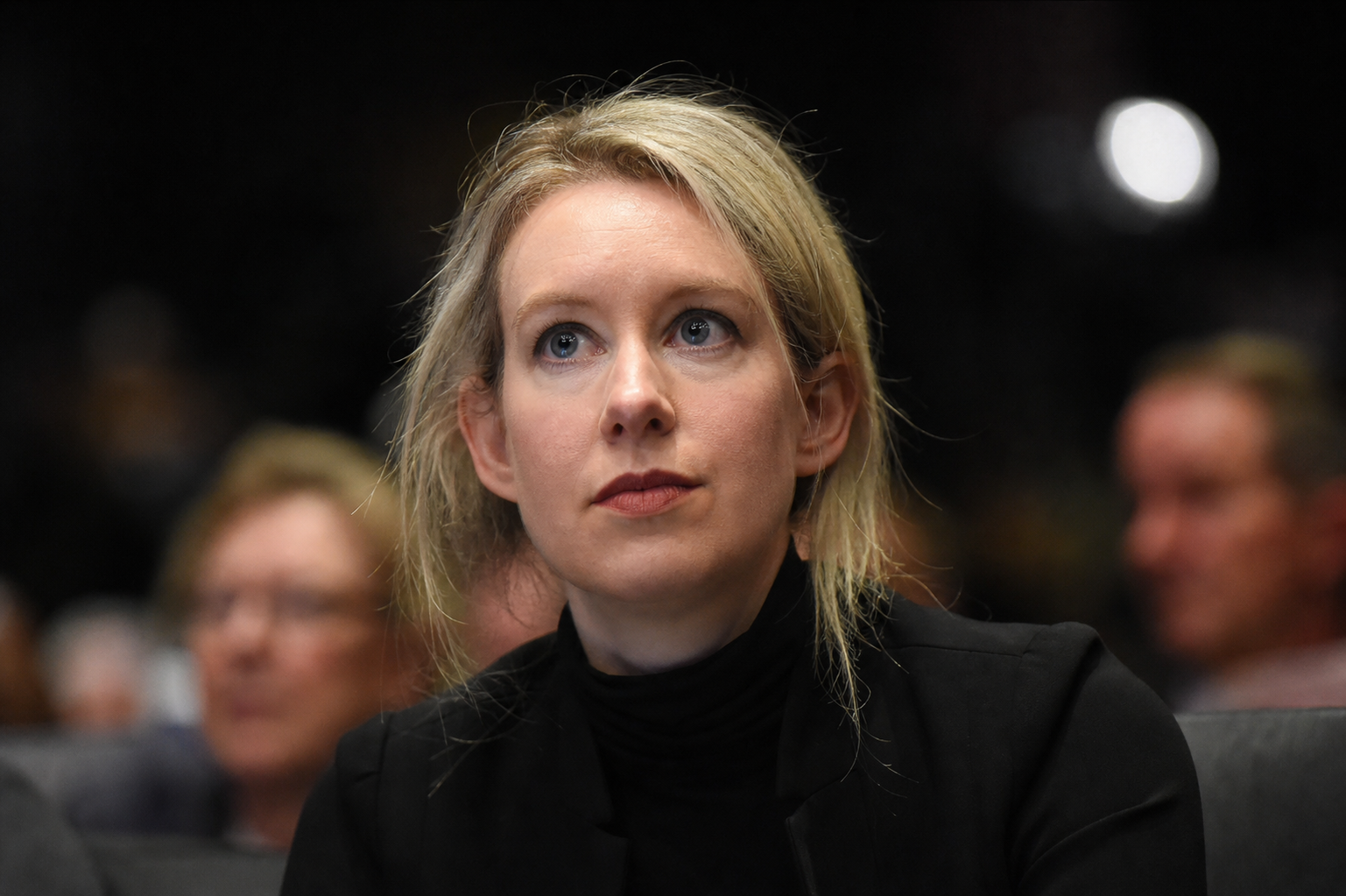
Elizabeth Holmes’s return to the public conversation arrived in cinemas, not a courtroom. You Can See Everything, Nathan Fielder and Lance Oppenheim’s documentary about the Theranos founder and her partner Billy Evans in the weeks before she entered prison, opened in the United States on October 16 with about $15 million in ticket sales — an extraordinary result for a nearly three-hour documentary. The scale matters because Holmes is not merely a compelling disgraced founder.
A federal jury convicted her in January 2022 of conspiracy to defraud investors and three counts of wire fraud involving individual investors’ transfers of more than $140 million. Ten months later, she was sentenced to 135 months in prison. She began serving her term in May 2023; it was subsequently reduced to 123 months.
Yet the new film, books, television adaptations and the churn of social platforms have turned the Theranos collapse into an endlessly renewable cultural property. That can illuminate the seductions that surrounded Silicon Valley’s most notorious healthcare start-up. It can also change the centre of gravity: from patients, laboratory staff and investors who were misled to the charismatic founder who misled them.
A market for the founder’s story The film’s commercial arrival gives Holmes a larger audience than most convicted corporate fraudsters receive after sentencing. Reviews have been strikingly enthusiastic, and the box-office opening has been described as the biggest for a documentary in North America in more than two decades. Its premise is intimate: Holmes and Evans invited filmmakers into their lives as her prison term approached. That access is not evidence of exoneration. But it is powerful narrative material. A camera trained on a defendant’s home, relationship and impending separation naturally creates room for vulnerability, endurance and private feeling. The legal record is less cinematic: a jury found that Holmes defrauded investors, while federal prosecutors said the scheme cost them hundreds of millions of dollars. The danger is not that viewers will forget the verdict altogether. It is that the verdict becomes one plot point in a more emotionally satisfying story of ambition, collapse and personal punishment. Social media intensifies that conversion. Short clips, reaction posts and arguments over whether a subject is sympathetic reward revelation and identification; they do not reward the patient work of checking assay performance, laboratory validation or the limits of a blood sample. Holmes remains subject to a far more concrete judgment than the culture’s shifting mood. The US Department of Health and Human Services inspector general excluded her for 90 years from federal healthcare programmes, citing evidence that the Theranos device could perform only a small number of tests and that its results were less accurate than conventional machines.
“A drop of blood doesn’t hold nearly enough biological information” for the hundreds of tests Theranos claimed, scientists told Scientific American.
The problem Theranos exploited has not vanished
That scientific constraint is the point most easily lost when Theranos is retold as a parable about one founder’s lies. Holmes did not invent the desire for easier diagnostics. Conventional blood testing can mean a clinic visit, a trained phlebotomist, labelled tubes, transport, laboratory processing and a wait for results.
For patients in remote areas, people managing chronic conditions and families without easy access to care, each stage can be a barrier. The vision of many tests from a finger prick was therefore commercially brilliant as well as medically appealing. It promised less pain, less delay and a route around an expensive, fragmented system.
Theranos sold not only a machine but relief from the friction of ordinary healthcare. But an attractive problem does not make an impossible answer true. Scientists assessing the Theranos legacy say that more than a decade of advances in microfluidics and clinical testing have not changed the basic limitation at the scale the company advertised.
A single drop does not contain enough material to deliver hundreds of reliable tests. Different tests also demand different handling, accuracy thresholds and quality controls. That does not mean diagnostics have stood still.
Decentralised testing, smaller instruments and better sample handling continue to develop. It means the honest version of innovation is slower and narrower than the Theranos promise. Healthcare rarely rewards that truth as lavishly as a grand claim of disruption.
Fame should not revise the evidence
The documentary may prove valuable if it leaves audiences with that tension rather than a softened portrait of its subject. Holmes was not punished for having a difficult dream about blood testing. She was convicted for fraudulently presenting what Theranos could do to investors.
Her case still deserves retelling because the conditions that made it plausible remain visible: costly access to care, public impatience with medical bureaucracy and an investment culture that too often treats secrecy as proof of genius.