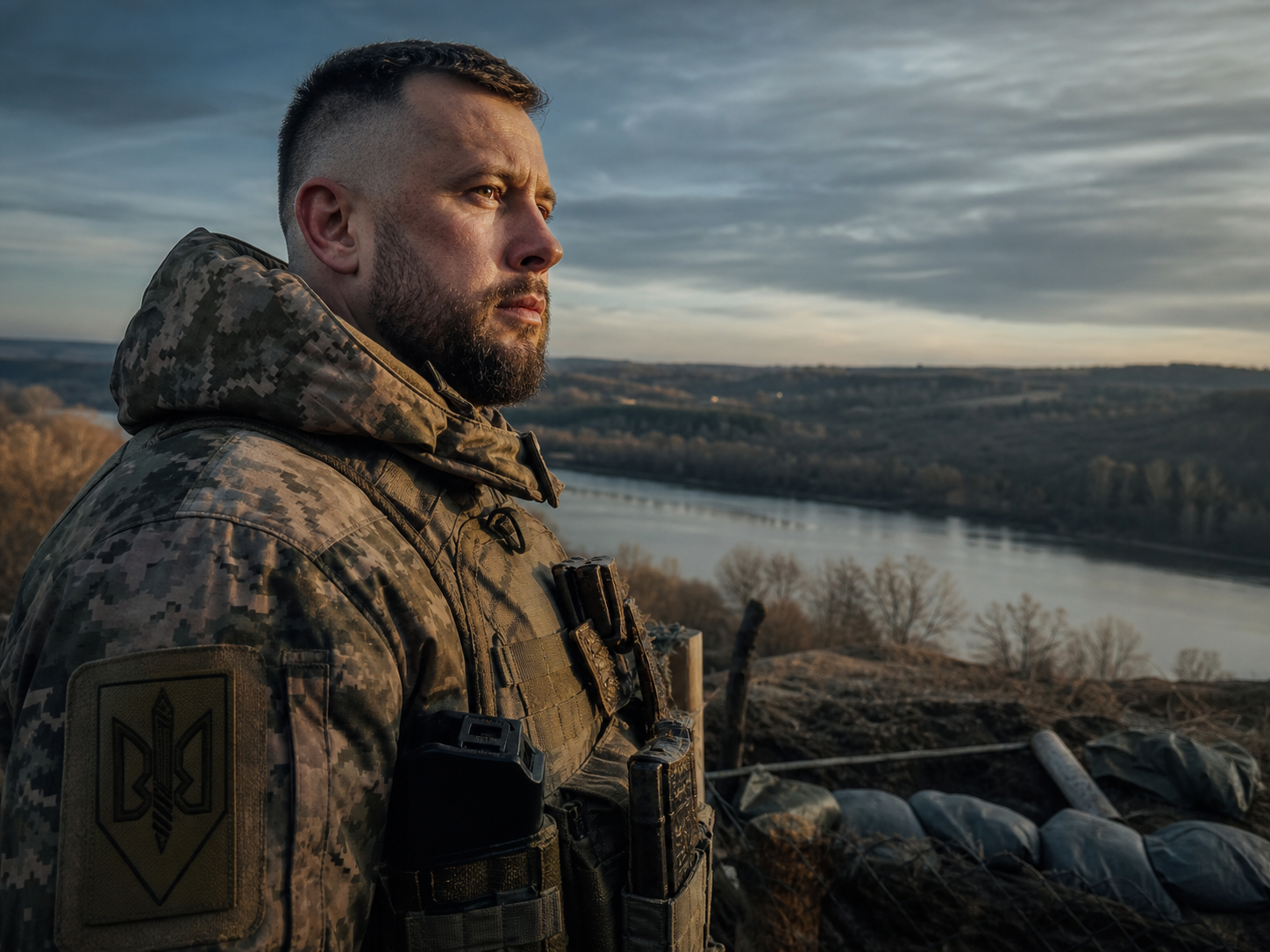
Russian forces north of Lyman are struggling to withdraw across the Zherebets River, leaving isolated positions near Ivanivka and Zarichne, according to the Institute for the Study of War’s assessment of September 27. That is the immediate, still-contested result of Ukraine’s Operation Vivaldi — and it has arrived at an awkward moment for Moscow’s timetable in Donetsk. The Ukrainian 3rd Army Corps, commanded by Brig.
Gen. Andriy Biletskyi, announced the operation on September 15 after a period of deliberate silence. It said its first phase had cleared 75 square kilometres of Russian infiltrators and liberated 10 square kilometres, including Serednie.
Five days later, the corps said it had liberated Shandryholove and Derylove and secured full control of Drobysheve. Those figures require care. The corps says it recovered 125 square kilometres across both phases, including roughly 50 square kilometres formally de-occupied; they have not been independently audited.
But ISW’s September 24 assessment also treated the elimination of the Russian salient north of Lyman as a meaningful operational development. It said the setback had likely forced Russian commanders to reconsider a wider attempt to encircle the Sloviansk-Kramatorsk-Druzhkivka-Kostiantynivka “fortress belt” through Lyman and Dobropillia.
“The 3rd Army Corps has launched an offensive operation in this direction under the name Vivaldi,” Biletskyi said on September 15. That does not make Vivaldi a breakthrough, and it does not mean Russia’s Donbas offensive has collapsed.
It does, however, suggest that a campaign designed to grind westwards is being made to spend time and manpower repairing its own northern flank.
A deadline slipping into the mud
Russia’s problem is not only tactical. It is calendrical. Pavlo Palisa, deputy head of Ukraine’s Presidential Office, said on September 7 that Russia’s political leadership wanted the remaining Donbas captured by the end of 2026, while its military had sought to push the target to March 31, 2027.
Palisa said Moscow had already postponed such deadlines 15 times, and that Ukraine still held 21-22% of Donetsk Oblast. That is a Ukrainian official account, not a confirmed Russian planning document. Yet the broader arithmetic is hard to ignore.
ISW said on September 7 that, at Russia’s August pace of 2.36 square kilometres per day in Donetsk, it would take until October 2032 to capture the rest of the oblast. On September 26, ISW assessed that Russian forces had made near-zero net gains since March 2026. The point is not that Russia cannot still take ground.
It can, especially where it concentrates men, glide bombs and drones against a narrow sector. The point is that each costly advance now competes with other demands: holding exposed salients, replacing losses, protecting logistics and preparing for winter operations. Ukraine’s President Volodymyr Zelensky said on September 27, citing commander-in-chief Mykhailo Drapatyi, that Russian forces had suffered 10,660 killed and wounded across the front in the preceding week.
The figure cannot be independently verified. The 3rd Army Corps has separately claimed more than 3,000 Russian losses during both phases of Vivaldi, including about 800 in phase two. Those claims should be read as indicators of the intensity of fighting, not settled casualty accounts.
Weather may complicate both sides’ calculations. ISW reported on September 24 that a Ukrainian brigade near Kupiansk had seen Russian attacks decline with the rainy season, which it said made drone launches harder; mud was also limiting heavy equipment in Zaporizhzhia. Yet weather is not a Ukrainian ally by default.
ISW warned on September 26 that fog could help Russian troops infiltrate across the Kakhovka reservoir bed.
Moscow’s winter answer
The battlefield slowdown may help explain why Kyiv and its partners expect the coming winter to bring a heavier long-range strike campaign. ISW assessed on September 26 and 27 that Vladimir Putin may be shifting towards attacks intended to force Ukraine’s capitulation over winter 2026-27. On September 25, Putin said Ukraine “must feel” retaliatory strikes.
The scale is already visible. Zelensky said on September 27 that Russia had launched more than 2,200 drones, about 1,650 glide bombs and 38 missiles in one week. Russia’s growing use of jet-powered Geran drones is especially troubling because they cut warning time and strain the economics of air defence.
Zelensky said on September 26 that Ukraine had intercepted more than 1,500 of 2,730 jet-powered Shaheds launched during September to that point — a 55% rate. That is a significant number of successful interceptions, but it also means hundreds got through. Ukraine stopped publishing broader missile-interception data on August 11, leaving a narrower public picture of the air-defence contest.
Ukraine’s Energy Minister Denys Shmyhal said on September 25 that Kyiv had obtained two Russian documents detailing planned winter strikes on energy infrastructure, heating and water systems. He said more than 200 protective structures had been built around priority targets. The documents themselves have not been made public.
Prime Minister Serhii Koretskyi offered a sober version of preparedness on September 27: more backup power at critical facilities, stronger protection for important infrastructure, more reserve equipment, repair crews and machinery. But he also said the €5.4bn energy-resilience plan was not fully financed and that damage from the previous winter had not been fully repaired. That is the central winter tension.
Ukraine is better prepared than last year in several practical ways, but not insulated. A more resilient grid can still be worn down if Russia sustains the volume of drones and missiles needed to find weak points. Air-defence resupply remains equally opaque.
Zelensky announced on September 24 an agreement on a new shipment of Patriot missiles, but did not identify the supplier, quantity or delivery date. The US State Department approved a possible $2.7bn air-defence sale on September 18. Britain, meanwhile, committed £100m to NATO’s Prioritised Ukraine Requirements List on September 8; Forces News reported that roughly 90% of Patriot interceptors reaching Ukraine now come through that mechanism.
A war built around machines
Ukraine’s answer is not simply to acquire more expensive interceptors. It is to make the war cheaper for itself and more dangerous for Russia. Zelensky said on July 15 that Ukraine was producing 10 million drones a year and aimed, with partners, for 20 million.
Britain said on September 8 that it planned to provide more than 120,000 drones to Ukraine in 2026, with 25,000 already delivered. Production claims do not automatically translate into usable systems at the front: components, electronic warfare, trained operators and unit-level supply all decide whether output becomes combat power. Still, the shift is apparent around Lyman.
The 3rd Corps said unmanned ground vehicles cleared 30 kilometres of routes towards Shandryholove of mines in two nights and now neutralise about 60% of anti-personnel mines in its area. ISW reported those claims on September 24. The corps also said heavy bomber drones had dropped kamikaze ground robots more than 10 kilometres behind Russian lines — a tactic intended to reach logistics targets without sending soldiers into the same danger.
Ukraine’s Defence Ministry said on July 20 that it had contracted more than 22,000 unmanned ground vehicles for 2026, almost twice the number for all of 2025. It reported 16,600 logistics and evacuation missions by such systems in June, 122% more than in January. The machines carry ammunition, remove wounded personnel and work routes where a driver would be exposed.
This is not a robotic substitute for manpower. Ukraine’s mobilisation remains in force for men aged 25 to 60, while Kyiv’s military intelligence says Russia’s General Staff plans to mobilise 300,000 people in 2026 and another 300,000 in 2027 — an assertion Putin has denied. Both armies still require infantry to hold ground, clear buildings and exploit a local reverse.
Vivaldi therefore offers a narrower but important lesson for the winter ahead. Ukraine may be learning to use drones, interceptors and ground robots to disrupt Russian momentum before it becomes another slow advance towards the fortress belt. Whether that is enough depends on questions still unanswered: when Patriot missiles will arrive, whether interceptor drones can be fielded at scale against jet Gerans, how long damaged energy infrastructure can be kept running, and whether Ukraine can sustain its own manpower.
For now, the Zherebets is less a line of triumph than a line of pressure. Russia is being forced back across it in places. The larger test is whether Ukraine can turn that pressure into a winter in which Moscow spends more effort preserving its campaign than advancing it.