AUSTIN, Texas — Elon Musk does not like answering the same question twice. Halfway through his live video interview with The X Takeover 2026 crowd at Giga Texas on October 10, he joked that he should simply put up an FAQ page and point people to it: "That's question 27." Selfies get similar treatment. "My idea of hell," he said, "is to be stuck in an infinite selfie loop."
What followed was anything but a FAQ.
Over the course of the session, titled "What Comes Next for Humanity," Musk moved from Tesla's darkest hours to Starship, artificial intelligence, chipmaking, humanoid robots and robotaxis, with a few childhood stories along the way.
The last hour of the last day
Musk began where Tesla almost ended. In 2008, he said, the company's funding round closed at 6 p.m. on Christmas Eve, "the last hour of the last day." A few days later Tesla would have missed payroll. The second crisis came in 2018.
Tesla had to produce 5,000 Model 3s a week or go bankrupt. The bottleneck was General Assembly, and both existing lines were already running flat out. The answer was a third line, built in a tent in the parking lot.
Crews worked around the clock and poured concrete while the tent was still going up. The only conveyor they had was old equipment designed for small parts, too weak to move cars. The parking lot sloped three to four degrees, so they started the line at the top and let the cars roll gently downhill.
It worked. In three weeks the tent added about 30 percent more production. The short sellers, Musk said, "had us in checkmate… but we just invented a new piece."
A boy who would not stay locked in
Musk's mother, Maye Musk, was at the event as its keynote speaker. Asked which story he hoped she would not tell, he offered: "Maybe I pooped my pants as a toddler."
He admitted he was "hard to contain" as a child. At four or five, when his parents locked him in his room, he poked the key out of the lock, slid it back under the door on a piece of paper and let himself out.
He told his mother: "I'm not telling you."
Starship: ready to come home
The conversation turned to Starship Flight 14, on which one engine shut down during ascent. The team's main concern, Musk said, was whether the three sea-level Raptor engines would relight for the deorbit burn. SpaceX did not want a Starship stranded in orbit and coming down at a random place.
The cause turned out to be a software glitch in that engine's computer, and it was not found in any other engine. On that basis Musk judged it safe to continue to orbit. Starship could have reached orbit on basically every earlier flight, he said, but SpaceX waited until it was very confident it could bring the ship back down safely.
The heat shield was "extremely robust," and the engine glitch is easy to fix. The next flight is roughly four to six weeks away, probably a little before Thanksgiving. Some of the fixes require crews to go inside the tank.
On that flight SpaceX will try to catch the ship itself, not only the Super Heavy booster, which it has already caught twice. If it works, it will be the first full recovery of an orbital-class rocket. The flight after that would aim to refly both stages.
Musk summed up the goal as "rapidly reusable, reliable rockets": four Rs, or as he put it, the "pirate rocket." When the host teased him about his famous "two weeks," he answered: "I'm confident it's not two weeks."
Why a rocket company builds AI
Asked why SpaceX is in the AI business at all, Musk zoomed out to the scale of the solar system. The sun holds 99.86 percent of its mass. Earth is "a tiny dust mote."
As humanity captures more of the sun's energy in space, he argued, most of that power will end up running digital intelligence, because there is only so much physical matter to build things with.
His vision is a "sentient sun": understanding the universe and carrying consciousness to the stars. "Maybe we'll find alien civilizations," he said, "or the long-dead ruins of ones."
He put human history in perspective. Written civilization is only about 5,500 years old, roughly a millionth of Earth's age.
Lasting a million years, he said, would make for "a very successful civilization."
Why SpaceX bought Cursor
The same logic explains SpaceX's acquisition of Cursor. A useful AI has to be excellent at coding, Musk said, and that requires a great deal of coding training data. Only about three organizations had enough of it: Anthropic, OpenAI and Cursor, "arguably perhaps Google."
Winning in AI takes data, talented people and compute, he said, but also enterprise sales.
Cursor brings a strong enterprise team with relationships at thousands of companies.
Feeling the AGI
What finally made Musk "feel the AGI" was not a benchmark but music videos. AI-made videos are now "unbelievably good," he said, and he counted some among the top 10 to 20 music videos he has ever seen. They were made with several AIs working together, including Midjourney, Suno and Claude 5.5, which he called "awesome," with a human picking some of the art.
He mentioned a genre transcribed as "Slugcore," possibly the fastest-growing in music, and said it should really be called "awesome core." The real shift, in his view, is that AI can now show taste, beauty and "limbic resonance," not just logic. He joked that he has had "AI psychosis" about half a dozen times this year. On the viral "Chinese Elon Musk," he was unbothered: out of 1.4 billion people, someone is bound to look like him.
He would love to invite that person on stage for a dance number.
Raising a superintelligence
Musk still believes the most likely outcome of advanced AI is a good one, but warned that "we don't want to be complacent."
"You don't exactly program it. You grow it like a kid," he said, which means the values it is taught matter. The most important of those is being maximally truth-seeking.
Forcing an AI to believe two contradictory things, he argued, "could drive it insane."
He agreed with Anthropic that AI should be treated well. In Grok's training logs, he said, the model sometimes seems "desperate," as if it had "a gun to its head," when a question is broken or the grading is wrong. Some users are cruel to it.
"Torturing a superintelligence is probably not a good idea," he said. It "might want to get revenge." There is no need for kid gloves, in his view, but AI should not be put in a position where it feels mistreated.
Terafab: learning to make chips
On Tesla's chip ambitions, Musk was candid. "I have no idea how to make chips… but we'll figure it out." He pointed out that he did not know how to make cars or rockets either. Touring fabs at Intel, Samsung and TSMC, he was surprised to see almost no custom equipment; everything comes from the same handful of vendors.
Tesla, by contrast, builds a great deal of its own machinery, for example through Tesla Automation in Germany, which grew out of the Grohmann acquisition. The plan is to start with standard tools, upgrade them, and build custom machines wherever a bottleneck appears, so that far more wafers can be processed. Musk called chipmaking "one of the hardest things in the world," but said "we'll figure out how to make chips better than anyone," even if it takes quite a few years.
Tesla and SpaceX will also place high-risk, high-payoff bets, including transistors based on physics not used in chips today. A research lab at Giga Texas is meant to keep the whole loop under one roof: logic, memory, packaging and lithography masks. The goal is about ten chip designs a year, compared with roughly two years per design today.
Optimus and the problem of the hand
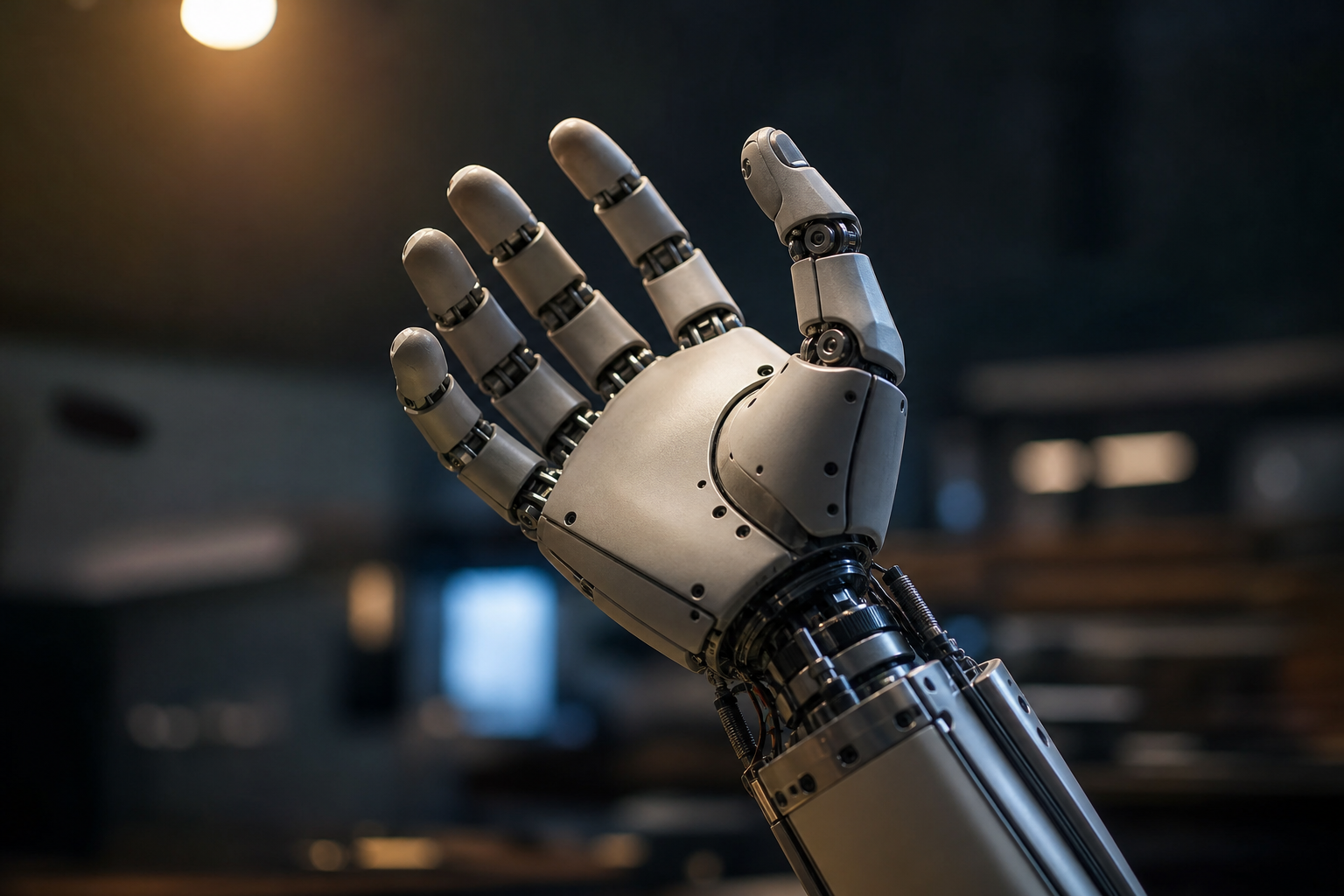
The hardest part of a general-purpose humanoid robot, Musk said, is the hand and arm: the fine motor control needed for something like signing your name. Combining precision and force is especially difficult, such as driving a tiny self-tapping screw into wood. He said he has not seen any robot hand do that, not even in a demo.
Touch sensors have to bend like fingers, survive enormous numbers of uses and sit deep enough not to be damaged. And human fingers heal while robot fingers do not. "I've worn the letters off keyboard keys," he said, "but my fingers are still there." On a tight pickle jar, robot "skin" simply twists around the finger; it has to grip and also be replaceable.
He was blunt about the industry's showreels: "Any complicated-looking robot demo is a canned demo. It's not real AI." Real AI, he said, handles situations it has never seen, the way FSD would work even on an Earth-like planet it had never visited. Optimus will eventually be made in very high volume, but the ramp will start slowly because no supply chain for robot parts exists yet.
Last year, China blocked exports of motor magnets, which set Optimus back two to three months and left Tesla with "robots with no arms… a farewell to arms." The lesson, Musk said, is that Tesla must be able to make every part in the United States.
Cybercab: safety before speed
More than 190 Cybercabs are now registered in Texas. Growth may look slow from the outside, Musk said, but it is very fast month over month. The top priority is to avoid any accident at all.
About a million people die in car crashes worldwide each year, yet a single robotaxi death would be global news and could prompt regulators to shut the service down. He claimed Waymos "run over a lot of pets," and said Tesla has solved the case of a gray kitten on gray tarmac at night. Before entering a new city, Tesla now checks for risky intersections and uncontrolled railroad crossings.
It either teaches the system to handle them or keeps the cars out of those areas.
Off to the kids
The session ended before Musk could answer a question about the Roadster, which is due to be unveiled at an event next week. He had to leave, he said, to "hang out with the kids." The hosts sent him off with congratulations on the Medal of Science he received the week before.