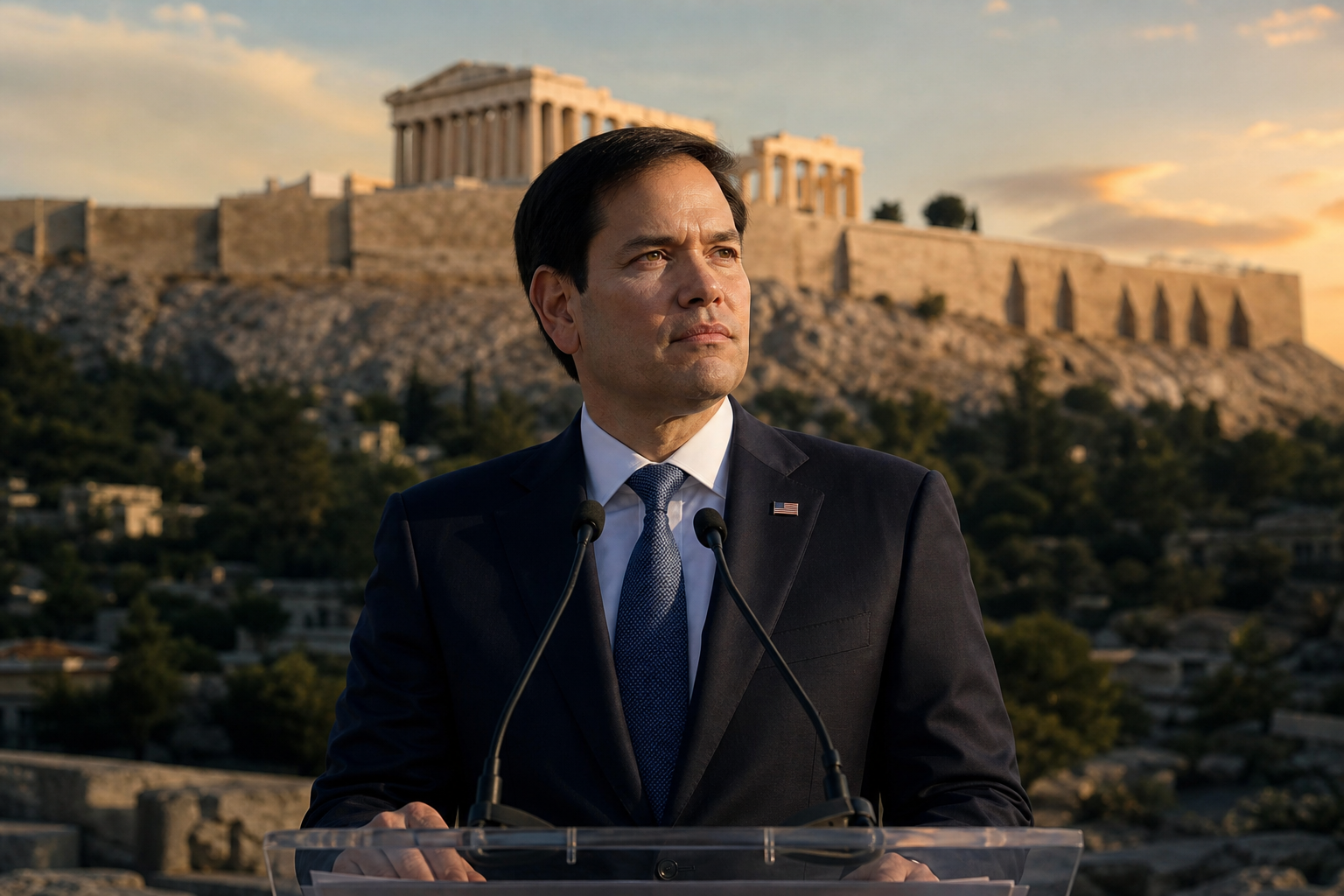
At sunset on Wednesday, October 7, from the Pnyx in Athens, Marco Rubio set out a demanding version of Atlantic partnership. The ancient hillside where Athenians once gathered for democratic assembly supplied the symbolism; the US secretary of state supplied a blunt modern test. The West, he argued, will retain its freedom and influence only if its nations rebuild the power, confidence and capacity to act.
“Under President Trump, the United States has made its choice.
We choose the unapologetic pursuit of national power,” Rubio said. The line was designed to travel. Yet Rubio’s Athens address was broader than a declaration of American self-assertion.
He placed US strength inside a shared Western project, arguing that allies must be capable enough to defend themselves, meet commitments and shape the world rather than be shaped by it. That is the clearest claim of the speech, and its most useful one. A stronger United States and more capable European allies are presented as mutually reinforcing, rather than competing, conditions for a durable alliance.
The Pnyx and the argument for renewal
Rubio reached back to ancient Greece to describe the West as a political inheritance rather than a temporary security arrangement. Civilisational rhetoric can easily become decorative. In Athens, it was tied to a recognisable strategic argument: countries that allow productive capacity, military readiness and public confidence to decay eventually surrender choices to stronger powers.
The BBC reported that Rubio warned Western civilisation faced the danger of “atrophy, servitude and decline”. The phrase gave the address its darker edge. Rubio was not offering nostalgia for an earlier Atlantic order.
He was arguing that decline follows when democracies accept dependence, drift and risk-aversion as permanent conditions. That diagnosis has particular force in Europe, where the costs of defence underinvestment and economic dependence have become harder to ignore. It also contains an implicit rebuke to Washington.
American leadership cannot be sustained merely through declarations of primacy; it requires allies that can carry real weight, and policies that allow them to do so. Rubio had raised related themes at the Munich Security Conference in February, when he argued that the United States and Europe needed to recover a shared Western identity. Athens gave that language a more concrete purpose.
The question was how democratic states can retain enough industrial, military and political capacity to cooperate on their own terms.
Europe hears an offer — and a challenge
For European governments, the speech offers a familiar bargain in more forceful language. Washington will continue to treat the Atlantic alliance as strategically important, but European capitals are expected to contribute more than rhetoric. NATO burden-sharing sits at the centre of that proposition: an alliance is more credible when its members can defend their territories, replenish their forces and take responsibility for difficult decisions.
European critics of the broader America First approach will still see a tension in Rubio’s formulation. National power can support an alliance, but it can also become a narrower measure of advantage. Trade disputes and tariffs are where that tension becomes most immediate.
A partnership built around strategic resilience can be weakened if economic pressure is used primarily to shift costs onto allies or settle political scores. Rubio’s speech did not dissolve those transatlantic disagreements. Its achievement was to set a standard against which they can be judged.
If the United States wants Europe to become more self-reliant, it must treat European strength as an asset rather than a threat. If Europe wants a serious voice in the alliance, it must match its language of strategic autonomy with defence investment, industrial capacity and political resolve. The tone also mattered.
CNN described the Athens speech as an effort to position Rubio as both heir to and moderniser of the America First movement. In Greece, he gave that project a more outward-facing form: national sovereignty as the basis for cooperation among states able to make and keep commitments. That remains an argument, not a settled transatlantic compact.
Europe will judge it through budgets, procurement decisions, trade policy and Washington’s conduct when allied interests diverge. But Rubio made an important point in Greece: alliances do not survive on sentiment alone. They endure when their members remain strong enough to choose one another.