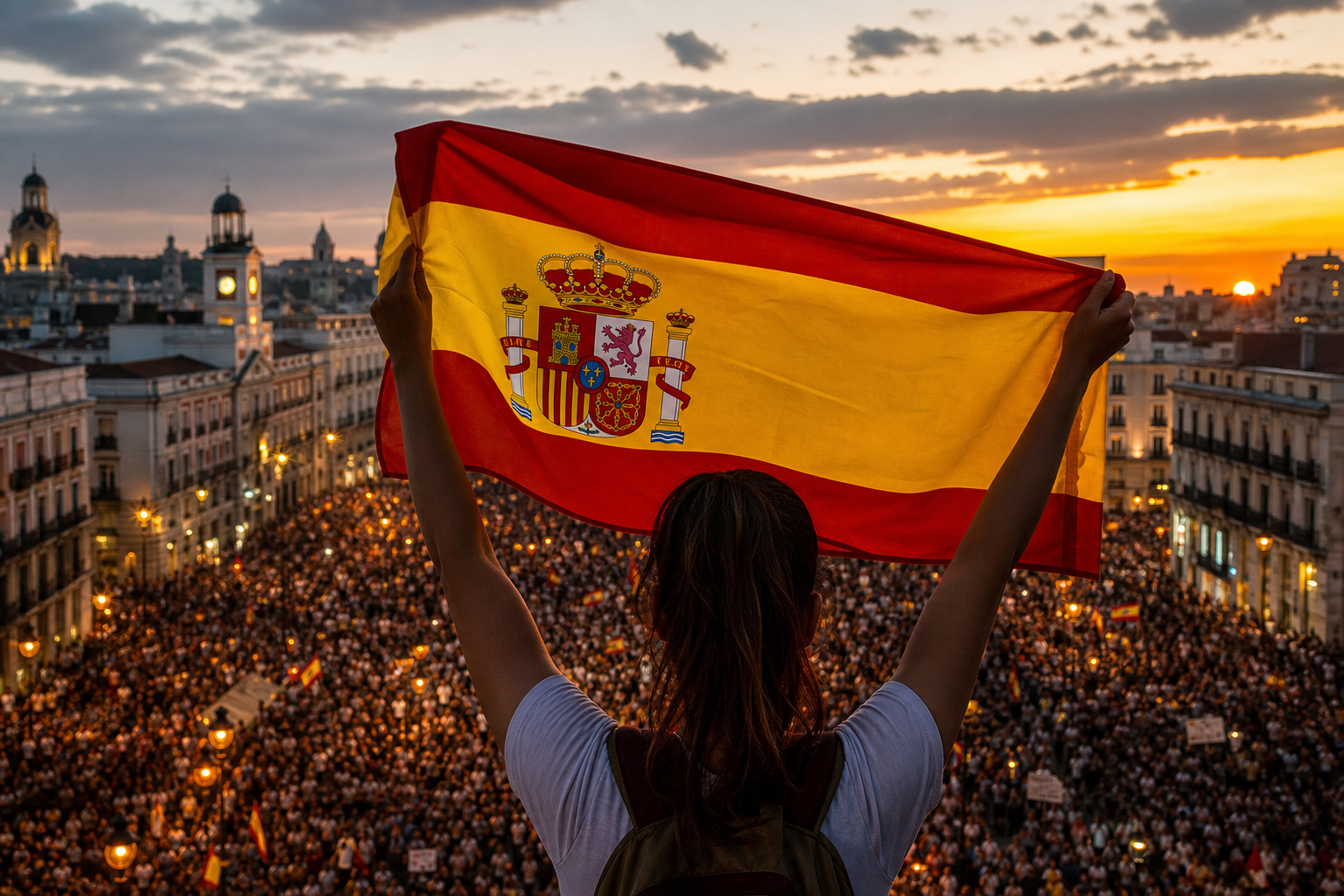
Spain’s Prime Minister Pedro Sánchez has called a general election for 29 November, turning a parliamentary defeat over housing measures into a national test of whether Europe’s centre-left can still hold its ground against a consolidating right. The decision, announced on 5 October after Sánchez’s minority government lost votes on tenant protections, came amid protests over soaring rents and evictions. It has handed Alberto Núñez Feijóo’s centre-right People’s Party an early advantage — and made Vox, the hard-right party now running third in polling, still more central to the question of who governs Spain next.
A 40dB poll for El País and Cadena SER, published on 5 October, put the PP on 31.6%, Sánchez’s PSOE on 27.4% and Vox on 18.4%. The two right-wing parties together reached 50% of intended votes. That is not a result, and Spain’s electoral map can distort national vote shares into very different seat totals.
But it points to the political arithmetic that now shadows the campaign: Feijóo may be able to replace Sánchez only with Vox’s support.
“A broader progressive majority” is needed to overcome resistance to reform, Sánchez said in announcing the election. The immediate trigger was Spanish: a housing crisis, a fragile minority administration and legislation that could not survive parliament. Yet the timing places Spain within a wider, less tidy pattern.
From Brazil’s presidential runoff to France’s long campaign for 2027, established centre-left forces are defending power or relevance while parties of the right — in several cases the far right — find new routes to influence.
Brazil’s family name and
France’s wager Brazil offers the starkest version of that pressure. Flávio Bolsonaro, son of the former president Jair Bolsonaro, finished first in the 4 October presidential vote with 47.1% of valid ballots, against 45% for the left-wing incumbent Luiz Inácio Lula da Silva, according to the Superior Electoral Court results reported with most ballots counted. The pair are due to meet in a 25 October runoff.
Jair Bolsonaro, who was convicted over a coup plot and remains barred from running, is not on the ballot. But his surname is. Flávio Bolsonaro’s near-majority first-round showing has made the family brand the vehicle through which Brazil’s far right could return to the presidency only four years after Lula defeated the elder Bolsonaro.
The runoff is not decided. Lula has recovered from difficult campaigns before, and the first-round gap was narrow. But the political fact is already clear: an incumbent of the Latin American left entered the final round behind a Bolsonaro, with little time to alter the race’s direction.
France is further from an election but no less revealing. On 5 October, a tracker of Polymarket prices put Marine Le Pen’s implied chance of winning the 2027 presidential election at 44.9%, ahead of Édouard Philippe at 18%. Those are market prices, not votes, and they should not be mistaken for a forecast.
They are also unusually high for a candidate whose party, National Rally, has repeatedly been blocked in decisive runoffs by coalitions of opponents. That old barrier is the real uncertainty. An analysis published on 30 September described Le Pen as a “coin flip” because the anti-National Rally transfer of votes that once worked reliably in runoffs appears less secure.
Whether it has actually broken will be tested only when candidates and ballots are known. Still, the market’s signal is that Le Pen is no longer being treated as an inevitable loser at the final hurdle.
Sweden shows the limits of a simple story
Sweden complicates any easy claim of a uniform rightward tide. In the 13 September election, the centre-left bloc won 176 seats to the right’s 173, while the Social Democrats remained the largest party. Yet Magdalena Andersson was unable to assemble a government and gave up her exploratory mandate late in September.
The Speaker’s consultations continue. No snap election has been called, and the deadlock could still yield a government. Prediction markets have continued to put the Social Democrats as likely participants in the next administration.
But the party’s narrow parliamentary edge has not translated into control, exposing a recurring problem for the European centre-left: winning the largest share of seats is not the same as finding a durable majority. Spain, Brazil, France and Sweden do not share one cause. Spain’s housing revolt is not Brazil’s Bolsonaro inheritance; France’s runoff politics are not Sweden’s coalition mathematics.
Nor are polls and prediction markets election results. What connects them is a harsher political landscape for centre-left governments and parties. Economic grievance, exhausted governing coalitions and fractured electorates are creating openings to the right.