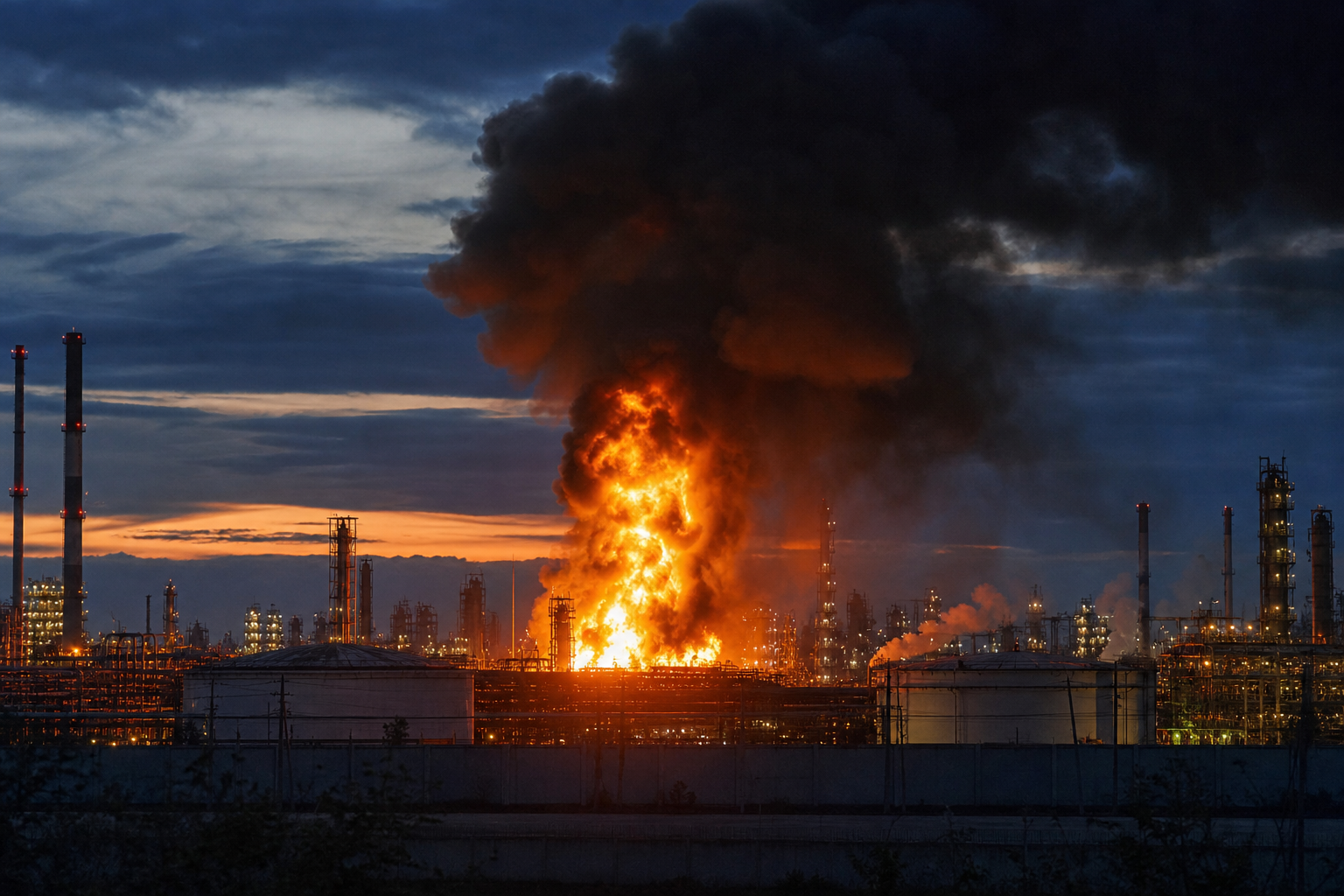
Ukraine ended its three-day pause on strikes against Russian refineries this week with a drone attack that set fire to Rosneft’s Ryazan plant, a major fuel facility southeast of Moscow, after President Volodymyr Zelenskyy said Russia had continued attacking Ukraine’s power grid and fuel depots. The strike turned a brief, U.S.-announced “energy ceasefire” into another failed experiment in wartime restraint. Ryazan Governor Pavel Malkov said emergency services were at the refinery and that officials were assessing material damage.
The full extent of damage, the status of individual processing units and any repair timetable were not immediately clear. Ryazan matters because of its scale and location. The refinery is one of Russia’s larger plants and an important supplier to the Moscow region.
A prolonged disruption would add pressure to a fuel system already repeatedly targeted by Ukrainian long-range drones, though one outage alone does not establish a measurable effect on Russian fuel availability or international diesel prices. Zelenskyy told the Financial Times that Kyiv had halted refinery attacks for three days after President Donald Trump announced the energy truce. But Ukraine concluded that Moscow had not reciprocated, he said, citing continued Russian strikes on Ukrainian electricity infrastructure and fuel facilities.
“The block [on attacking refineries] is out.
We’re done,” Zelenskyy told the Financial Times. The wording underscored the fragility of the arrangement. There was no publicly disclosed, mutually signed ceasefire agreement setting out monitoring, enforcement or penalties.
Instead, Kyiv’s pause appeared to be a unilateral response to a White House initiative, leaving both the meaning of compliance and the consequences of violation contested from the outset.
A pause without enforcement
For Ukraine, Russian attacks on energy targets have long carried a direct civilian cost: disrupted electricity, damaged generation and distribution equipment, and the prospect of winter shortages. Kyiv’s decision to resume refinery attacks framed Russian oil-processing capacity as a legitimate counterweight to that pressure, as well as a source of revenue for Moscow’s war effort. For Washington, the collapse of the pause is a more immediate diplomatic setback.
Trump’s surprise announcement created an expectation that a limited bargain could restrain attacks on the energy systems most exposed to civilian hardship. Within days, the initiative had instead become evidence of how little trust exists between the belligerents and how narrow the room is for externally brokered understandings without a verification mechanism. The Russian account of the Ryazan incident was confined to the regional governor’s confirmation of a fire and an assessment of damage.
Rosneft had not publicly detailed the refinery’s operating status in the material available, and there was no independent confirmation of which units, if any, had been forced offline. That uncertainty matters. Russia’s refining system is large and geographically dispersed, and the immediate effect of a drone strike depends less on dramatic images of a fire than on whether crude-distillation, conversion or loading equipment is damaged, and for how long.
The attack nevertheless demonstrates Ukraine’s ability to reach strategically important industrial sites well inside Russia.
Moscow’s airspace feels the pressure
The refinery strike came amid a wider run of drone alerts around the Russian capital. Moscow’s four principal airports — Vnukovo, Sheremetyevo, Domodedovo and Zhukovsky — suspended incoming and outgoing flights overnight into October 16, according to reports cited in the reporting provided. Another broad drone barrage early on October 17 again triggered emergency airspace restrictions, with some international services diverted to St Petersburg.
The airport disruptions are not equivalent to damage at a refinery, but they impose a different kind of cost: uncertainty in a capital Moscow has sought to insulate from the war. Repeated shutdowns interrupt passengers and freight, force airlines to reroute aircraft and make the conflict visible in the routines of Russia’s largest city. Russian authorities said air defences intercepted large numbers of drones in the October 17 attack, including drones headed toward Moscow.
Ukraine did not publicly claim every reported strike or give operational details, consistent with its usual caution around ongoing drone operations. The two sides are now back in a familiar escalation cycle. Russia’s continuing campaign against Ukrainian energy infrastructure gives Kyiv both a military rationale and a political argument for striking Russian oil facilities.
Ukraine’s refinery campaign, in turn, tests Russia’s air defences and threatens a sector central to domestic fuel supply and export earnings. Europe will watch the next stage closely as winter approaches. The immediate facts do not show a broad fuel-market shock, but they do show why energy security remains tied to the battlefield: a short pause, announced with presidential fanfare, lasted three days before fire returned to one of Russia’s most consequential refineries.