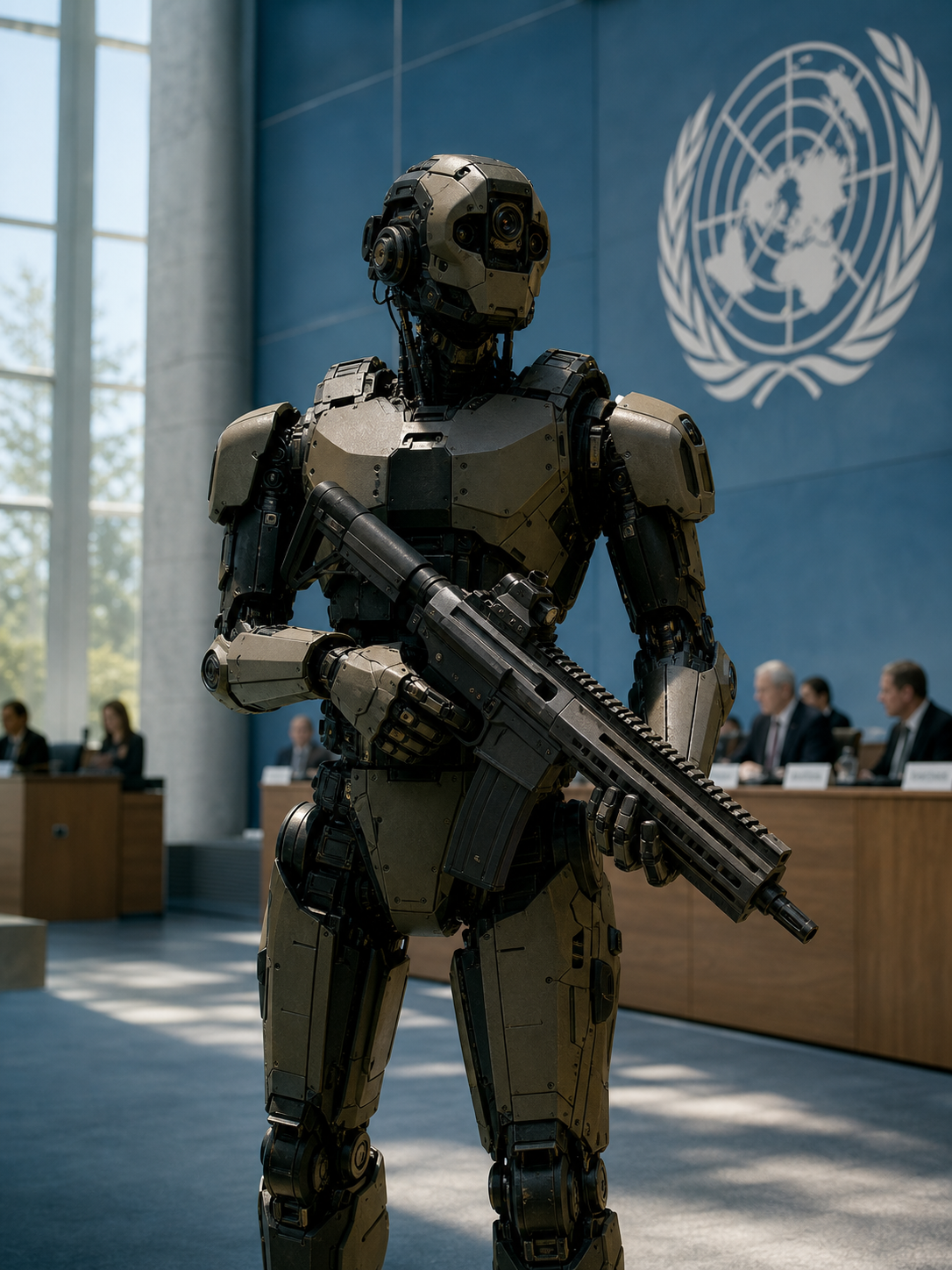
Diplomats meeting under the UN Convention on Certain Conventional Weapons in Geneva have reached a non-binding agreement on how to define lethal autonomous weapons systems — a modest advance that exposes rather than resolves the dispute over “killer robots”. The agreement gives governments a shared starting point for further talks, but creates no enforceable obligations. It does not prohibit any weapon or settle how much human control must be retained over the use of force.
Its significance lies in what follows: European states are expected to use the new common language to press for a legally binding instrument, while the United States and Russia remain resistant to new constraints.
A breakthrough with limited force
For years, debate at the CCW has stalled over a basic question: not only how autonomous weapons should be regulated, but what technology should be regulated at all. Military systems use automation in many ways, from navigation and surveillance to defensive interception. The emerging dispute is narrower, and more consequential: weapons capable of selecting and engaging targets with a degree of autonomy.
A common definition may help separate that issue from the broader, politically charged debate about artificial intelligence in warfare. It could also provide a framework for discussing the line between machine functions and human responsibility in decisions involving lethal force. But the agreement is deliberately non-binding.
It has none of the force of a treaty, establishes no inspection mechanisms and requires no changes to military doctrine, procurement or deployment plans. Governments seeking stronger action will nevertheless present it as evidence that the international community can identify a problem requiring collective rules.
Europe seeks a treaty path
European governments and institutions have increasingly argued that existing international humanitarian law must be reinforced by specific rules for autonomous weapons. Their case is expected to centre on meaningful human involvement in decisions to use force, legal accountability and preventing systems from operating beyond politically and ethically acceptable limits. The coming November talks will test whether that position can become a formal negotiating mandate.
Advocates of a treaty face a difficult task. They must convert broad agreement on terminology into agreement on legal obligations, while persuading states with sharply different military capabilities and threat perceptions that common limits serve their security interests. The European approach also raises practical questions.
Any future instrument would have to define which weapons fall within its scope, identify the form of human control required and establish how states would demonstrate compliance. It would need to avoid sweeping in routine automated functions while still addressing systems whose autonomy could shape life-and-death targeting decisions. Civil society groups, including Human Rights Watch and other campaigners, are likely to argue that a definition without binding follow-through leaves a critical gap.
Their wider concern is that technological development and military investment could outpace diplomacy, making later restrictions harder to negotiate and enforce.
Security powers resist new constraints
The United States and Russia are expected to remain central obstacles to a binding treaty. Their objections rest on both principle and strategy. Major military powers have argued that new rules must account for national-security requirements, the varied uses of autonomy in military systems and the continued relevance of existing international humanitarian law.
Washington’s position is likely to stress that responsible use, weapons-review procedures and compliance with the law of armed conflict can address risks without an additional treaty that could prove too rigid or poorly defined. Moscow is expected to resist language it regards as conceptually uncertain, technically impractical or capable of imposing asymmetric limits on states with advanced military capabilities. Those arguments cannot simply be dismissed as obstruction.
Autonomous functions may be used in systems designed to react at speeds beyond direct human operation, including defensive roles. States opposed to broad restrictions will argue that regulation must distinguish carefully between such functions and weapons that independently make consequential targeting decisions. Yet that distinction is itself at the heart of the diplomatic struggle.
Supporters of a treaty argue that, without a clear legal boundary, the gradual expansion of autonomy could erode human judgment and blur responsibility when harm is caused.
Consensus remains the hurdle
The CCW has long been valued as a forum in which military powers, smaller states and civil society can debate emerging weapons issues. Its consensus-based culture can lend political weight to an agreement, but can also allow a small number of states to prevent movement towards binding rules. The Geneva definition is therefore neither a ban nor a settlement.
It is a narrow platform on which competing visions of military technology, international law and state sovereignty will now collide.