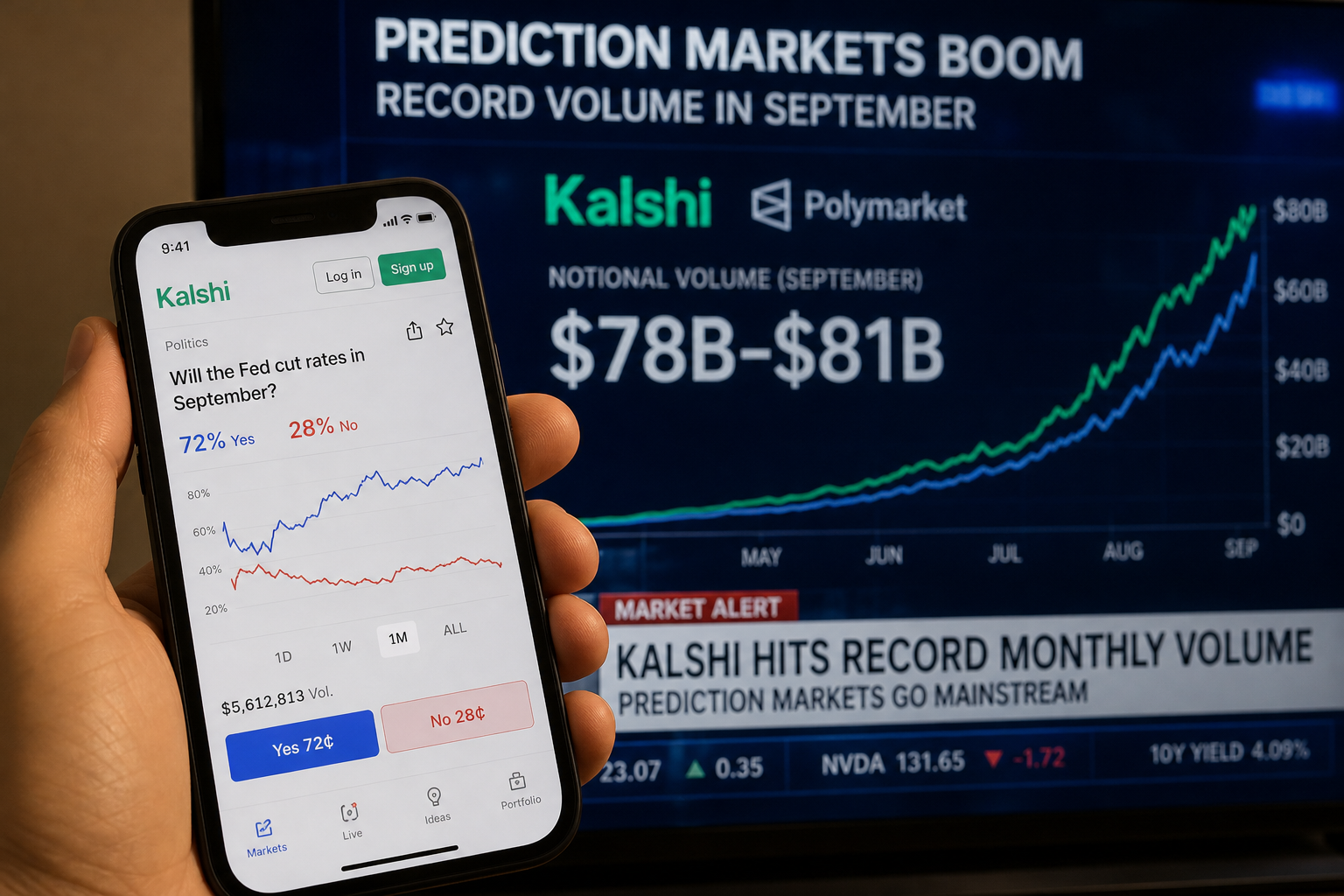
The numbers now flashing across American television screens have become too large to ignore. Prediction markets handled roughly $78bn to $81bn of notional trading in September, according to competing trackers — a monthly record in a business once treated as a niche wager on elections. For Wall Street and newsrooms, platforms such as Kalshi and Polymarket are being recast as a live oracle: a continuously updated price on who will win, what will happen and when.
For regulators in Scandinavia, the same mechanism looks much more familiar. It is gambling, offered without the licences required to take bets from local customers. That divide sharpened this week.
Denmark has blocked Polymarket among 98 unlicensed gambling sites, while Norway is moving to block both Polymarket and Kalshi after finding that their services appear to breach Norwegian gambling rules. The Nordic response is not a rejection of forecasting itself. It is a challenge to the idea that wrapping a wager in market language places it beyond gambling law.
A market becomes a media signal
The scale of the boom explains the urgency. Volume Race, an industry tracker, put notional volume across 10 exchanges at $188.91bn in the third quarter of 2026, up 81% from the previous quarter and more than 21 times the level a year earlier. It estimated that Kalshi accounted for 75.1% of activity, with Polymarket’s US and international operations together accounting for a little over 18%.
Notional volume is not revenue, nor does it show how much money users have deposited or lost. It measures the face value traded through the contracts. Still, the growth has made prediction markets impossible to dismiss as a sideshow.
Pew Research Center reported on September 23 that combined monthly global trading on Kalshi and Polymarket rose from $26bn in May to $53bn in July, largely driven by sport. The World Cup helped turn contests that once centred on presidential elections into an always-on market for matches, players and results. Capital has followed.
Polymarket reportedly raised about $1bn at an approximately $21bn valuation in September. Kalshi, valued at $22bn in a May funding round, was reportedly in talks to raise roughly $1bn at a valuation near $40bn. Those figures reflect investor expectations, not proven earnings; the platforms’ spectacular trading figures are a measure of turnover, not a conventional financial result.
News organisations have also helped normalise the products. Kalshi became CNN’s official prediction-market data partner in December 2025, with its information set to appear across programming led by the network’s chief data analyst, Harry Enten. It also struck a multi-year arrangement with CNBC.
Ahead of the US midterm elections, Kalshi added accuracy scores, low-volume labels and live trade feeds to election contracts — features designed to make its prices more legible as political signals. But a quoted probability can acquire authority faster than the market behind it earns trust. CNBC reported on September 30 that unusual patterns in some Kalshi perpetual-futures contracts and low-odds activity on certain Polymarket international contracts had raised questions about volume quality.
Both companies denied wash trading.
Nordic regulators see bets, not forecasts Denmark acted first. On August 19, the Danish Gambling Authority said it had DNS-blocked 98 sites that offered gambling aimed at Danish customers without a Danish licence. Polymarket was among them. The action followed a Frederiksberg Court ruling dated July 8 in a case involving Telenor. It was an enforcement action against specified unlicensed operators, not a parliamentary ban on prediction markets as a category. Danish internet providers are expected to apply the blocks under an industry agreement. Polymarket said it was disappointed and had appealed.
“If you want to play in the Danish market, you must also play by the Danish rules,” Denmark’s tax minister, Jakob Engel-Schmidt, said when the blocks were announced. Norway is now on a similar path, though the final decision has not yet been made. On October 8, the Norwegian Gaming Authority, Lotteritilsynet, said it had sent DNS-blocking notices to 62 gambling companies, prominently including Polymarket and Kalshi.
The companies have until October 15 to respond; a formal decision is expected shortly afterwards. Atle Hamar, the authority’s director, told Norwegian media: “We have in practice concluded.” The regulator’s position is that prediction-market contracts are bets structured as odds and must comply with Norwegian gambling rules when offered to Norwegians. Norway had already blocked 238 gambling sites, though users can bypass DNS restrictions through a virtual private network.
The enforcement power rests on section 32a of Norway’s Gambling Act, a DNS-blocking provision that took effect on January 1, 2025. Its practical limits are obvious. A block does not erase a website from the internet.
But it raises the cost of access and, more importantly, declares which legal regime the state believes applies.