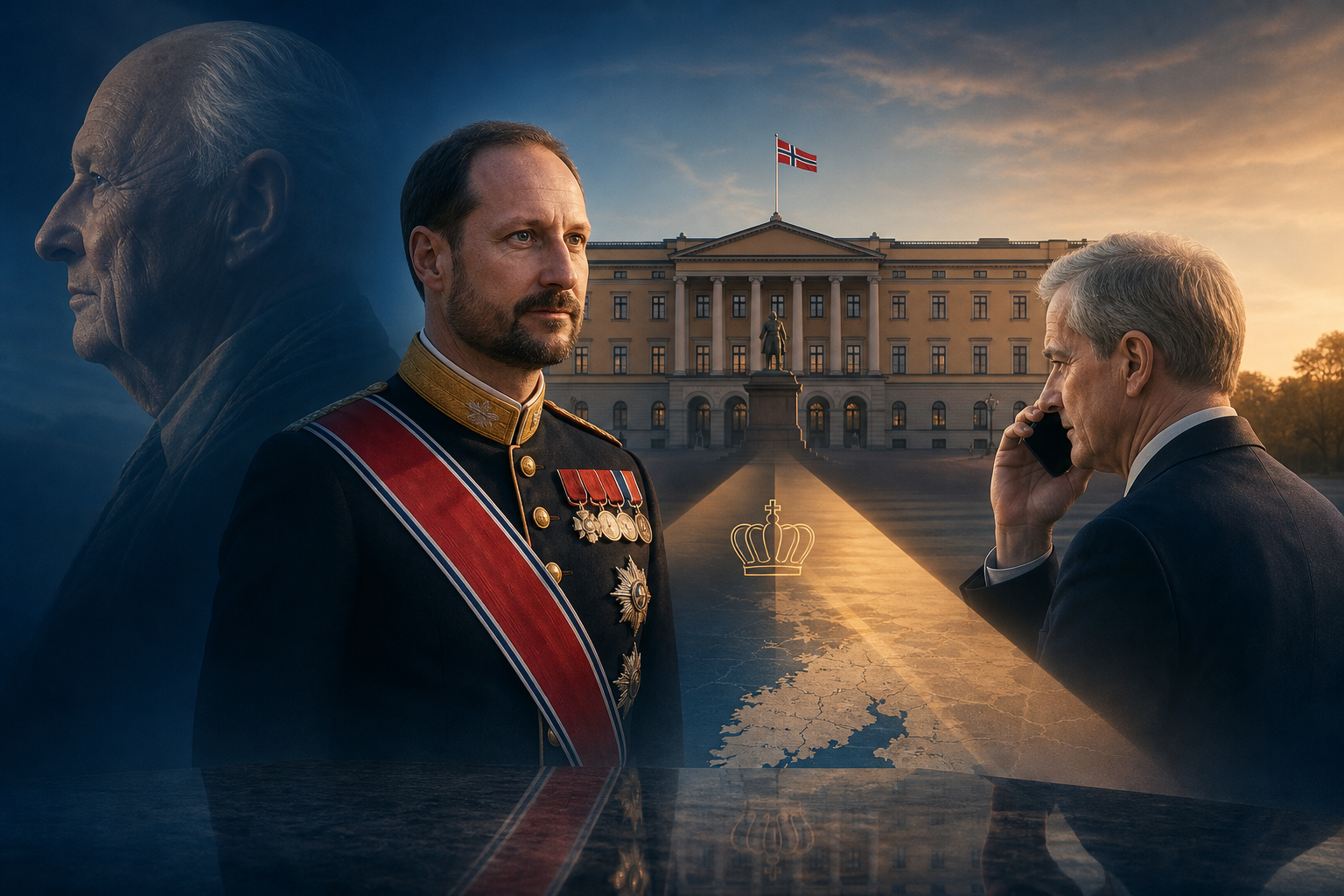
At 6.35 on Friday morning, Norway lost the king who had stood at the centre of its public life for 35 years. At the same instant, it had another. King Harald V died quietly at Rikshospitalet in Oslo on 28 August, aged 89, the Royal House announced.
His son, Crown Prince Haakon, succeeded immediately as King Haakon VIII — an abrupt personal loss absorbed by a system designed to ensure that the state never pauses. The sequence was both intimate and constitutional. The death of a father was followed by the accession of a son.
But there was no vacancy at the summit of the Norwegian monarchy, no waiting period for a ceremony, no interval in which the country was without a sovereign. The old formula — the king is dead, long live the king — acquired its modern Norwegian meaning in the space of a morning.
A call that marked the change
One of the first public indications of the new reality came in a call to Jonas Gahr Støre, Norway’s prime minister. Haakon introduced himself as the king. The gesture was spare, but it captured the character of the transition.
A new monarch did not emerge after days of ritual or political bargaining. He was already king when he placed the call. That distinction matters in a constitutional monarchy.
Ceremonies may give the public a moment to see and acknowledge a change. Councils of state and parliamentary observances provide the formal setting in which the institutions of government meet the new sovereign. But they do not create the succession; they follow it.
Norway’s royal household quickly began to mark both the death and the continuity that followed it. Its website carried the announcement of Harald’s death alongside notices headed “Transition of the throne” and “Everything for Norway,” the royal motto long associated with the Norwegian crown. An extraordinary Council of State was held on the day of the king’s death.
Later, Harald’s coffin was due to be brought from Rikshospitalet to the Royal Palace. The country’s mourning had begun, even as the machinery of continuity was already in motion.
A monarch remembered as a national figure
Harald had been king since 1991. The Royal House described him as Norway’s king for 35 years, a span that made his reign part of the background of ordinary national life for generations of Norwegians. His death brought an end to an era, but the public announcement was deliberately restrained.
“It is with deep sorrow that we announce that His Majesty King Harald passed away today,” the palace said. It recorded the place and precise hour of his death, and said that he had died peacefully. The economy of those words reflected the dual demand placed on a royal household at such a moment: to speak of bereavement while also signalling order.
The first task was to tell the country that its king had died. The second, inseparable from the first, was to make clear that the crown had passed on. For Haakon VIII, the accession changes a lifetime of preparation into a reign.
For Støre and the government, it establishes a new relationship with the head of state. For the Storting and the wider constitutional order, it is a transition that requires recognition and ceremony but not reinvention.
Continuity in a changed country
Modern European monarchies retain elaborate traditions, but their survival depends as much on predictability as on pageantry. Norway’s transition offered a stark example. The king’s death was announced on Friday morning; the new king’s position was not contingent on a coronation, a vote or an oath that might yet be taken elsewhere.
That is why the call to the prime minister carried such resonance. It was not a request for office. It was the first human exchange in a new constitutional reality.
The phrase “Everything for Norway” has accompanied the royal house through moments of celebration and national trial. On Friday, it appeared again in a different key: as Harald’s long reign closed and his son assumed the duties of the crown. The country will have time for condolence, procession and commemoration.
It will mourn Harald V as the monarch whose death has now been marked with deep sorrow. Yet the defining feature of the day was not uncertainty. Norway woke to the news that its king had died; it entered its first hours of mourning with King Haakon VIII already on the throne.